ATO supports Pakistan's efforts to advance low-carbon and resilient transport
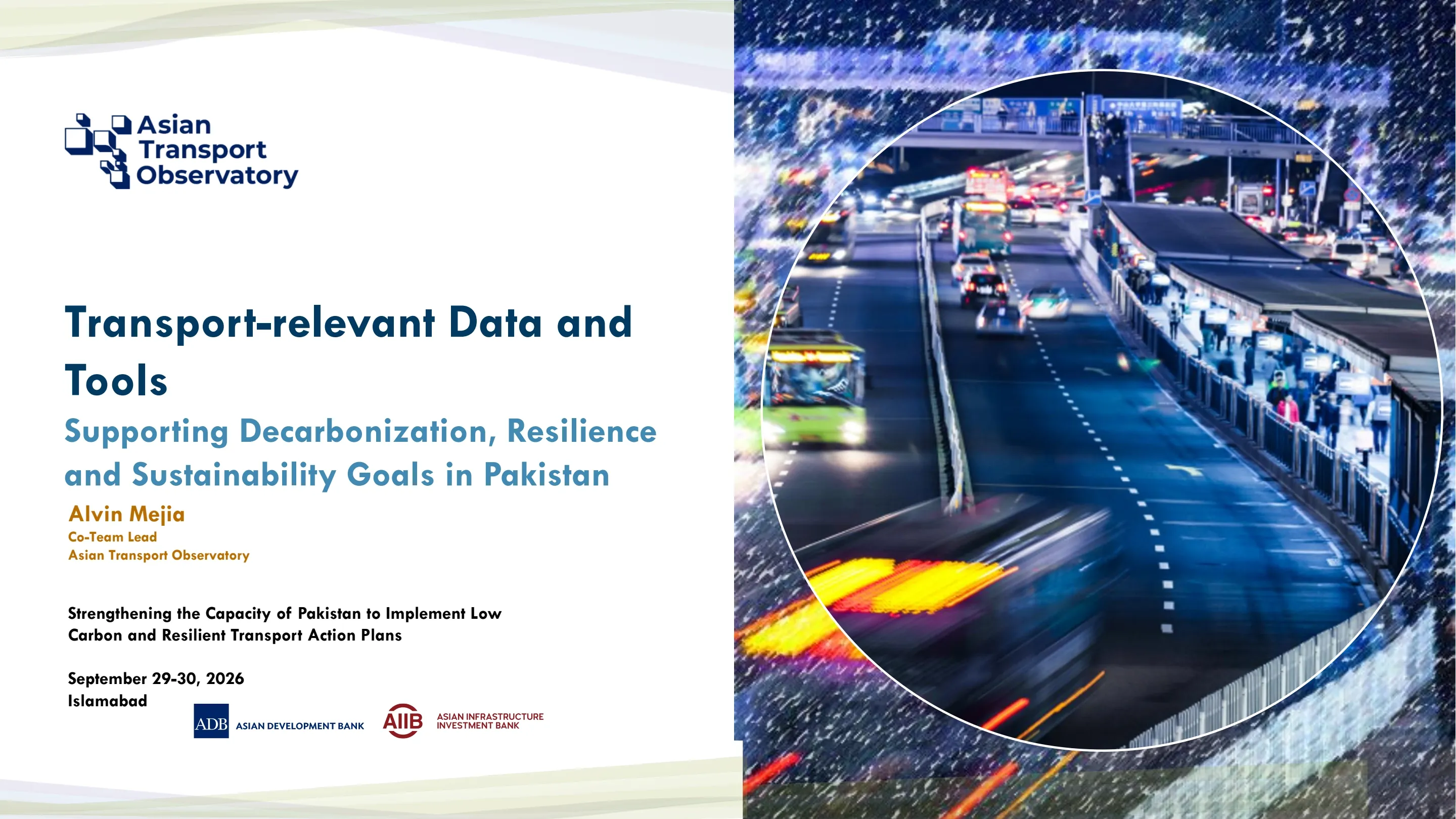
The Asian Transport Observatory (ATO) contributed data, analytical tools, and financing insights to a national workshop in Islamabad aimed at supporting Pakistan’s transition toward low-carbon and climate-resilient transport.
Held on 29–30 September 2026, the workshop, Strengthening the Capacity of Pakistan to Implement Low Carbon and Resilient Transport Action Plans, was organized by the United Nations Economic and Social Commission for Asia and the Pacific (ESCAP) and Pakistan’s Ministry of Communications, with support from the United Nations Economic Commission for Europe (UNECE). It brought together government agencies, technical experts, development partners, and other stakeholders to strengthen Pakistan’s capacity to develop and implement transport actions aligned with its national climate commitments.
The two-day program combined technical capacity building with policy dialogue. Discussions covered transport emissions and climate risks, the development and implementation of nationally determined contributions (NDCs), the draft national action plan for low-carbon and resilient transport, financing, institutional coordination, and the data and monitoring systems needed to support implementation.
Bringing transport data into policy discussions
ATO Co-Team Lead Alvin Mejia presented “Transport-relevant Data and Tools: Supporting Decarbonization, Resilience and Sustainability Goals in Pakistan.” The presentation demonstrated how ATO’s regional and national datasets can help connect transport evidence with practical policy, planning, and investment questions.
Using Pakistan as the focus, ATO brought together evidence covering transport infrastructure and connectivity, rural and urban accessibility, freight activity, transport costs and performance, modal shifts, road safety, energy consumption, greenhouse gas emissions, climate resilience, and transport finance. Rather than treating these as separate issues, the presentation showed how different datasets can be combined to provide a more complete picture of transport system performance and the challenges facing the sector.
This reflects ATO's broader approach to transport data: collecting information from multiple sources, curating and structuring it, connecting it to policy and investment questions, communicating the resulting insights, and strengthening the capacity of stakeholders to use evidence in decision-making.
The workshop also provided an opportunity to introduce participants to ATO's publicly available resources, including its National Database and transport finance tools. These resources can help countries benchmark trends, identify data and policy gaps, and strengthen the evidence base for transport planning and investment.
Connecting ambition with financing
On the second day, ATO contributed to the policy dialogue on financing and the enabling conditions needed to turn transport priorities into implementation. The discussion built on the technical sessions of the first day and considered how financing, institutional arrangements, data, monitoring, and coordination can support implementation of Pakistan’s low-carbon and resilient transport agenda.
ATO's presentation, “Insights – Financing Low Carbon Transport,” placed Pakistan’s financing challenge within the wider investment needs of developing Asia. It highlighted the scale of resources required for sustainable transport and examined the roles of public investment, development finance, private participation, and other financing sources.
For Pakistan, the analysis highlighted the significant financing implications of its climate commitments. Pakistan’s NDC 3.0 identifies an estimated USD 92.6 billion in financing needs for sustainable transport, accounting for around 30 percent of the cost of mitigation measures identified in the NDC. ATO also examined the country’s Public Sector Development Programme alongside these longer-term needs, helping frame the discussion around how climate and transport ambitions can be more closely connected with national planning and investment processes.
ATO's participation in the workshop demonstrated the role that accessible, well-structured transport evidence can play in moving from targets to implementation. By bringing together data on infrastructure, accessibility, emissions, resilience, policy, and finance, ATO is supporting a more integrated understanding of Pakistan’s transport challenges and the options available to address them. As Pakistan moves forward with its national action plan, continued improvements in data, monitoring, policy coordination, and financing will be important for translating low-carbon and resilient transport ambitions into concrete action.