Transport in Review Solomon Islands 2026 Released
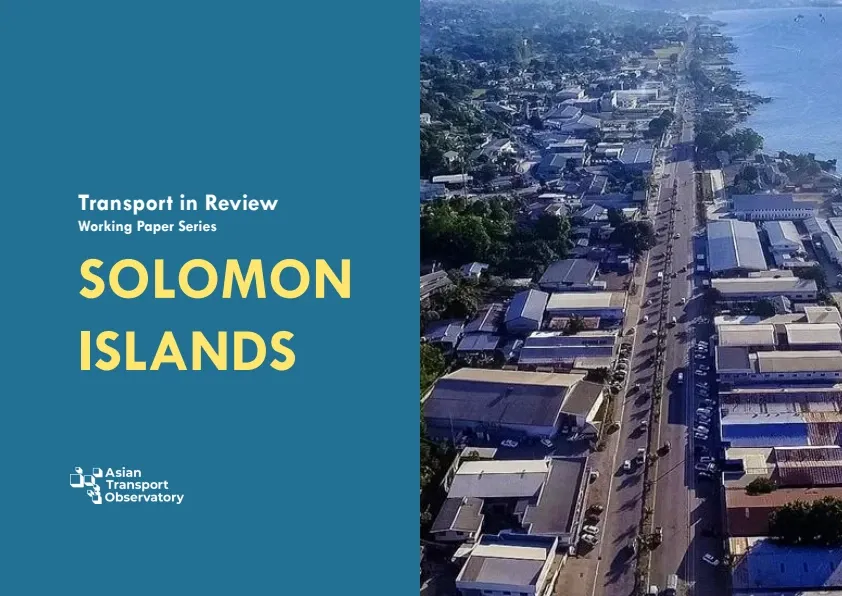
The Asian Transport Observatory (ATO) is pleased to publish a new working paper in the Transport in Review series: "Solomon Islands — Transport in Review Working Paper Series" This analytical paper examines the current state, performance, challenges, and opportunities of the transport sector in the Solomon Islands, with a focus on sustainable connectivity, safety, resilience, and economic development.
The Solomon Islands stands at a defining threshold. With a population of 819 thousand people dispersed across 992 volcanic and coral islands, the nation is poised to graduate from Least Developed Country (LDC) status in December 2027. This archipelago, stretching 1,600 km across the Southwestern Pacific, struggles with a tyranny of distance that limits its economic potential and social cohesion. Transport is the mechanism to bridge this divide, yet the current system is fragile. While the sector contributes 6-7 percent to the nation's gross value added, it operates under the strain of chronic under-resourcing, climate volatility, and structural inefficiency.
The Infrastructure Gap - The physical foundation of the economy is eroding. Official records list over 1,750 km of roads, but the reality on the ground is a sprawling, unmonitored network of approximately 3,440 km, suggesting vast unaccounted infrastructure. Quality has suffered. Only 67 percent of the core network remains in maintainable condition, and overall, barely 15 percent of the road network is rated fair to good. A structural disconnection exists: roads are built, but the bridges to connect them are missing, severing economic corridors.
Maritime transport remains the lifeline for domestic trade, yet it relies on a fleet of vessels with an average age of almost 30 years—end-of-life assets that are inefficient and unsafe. Port infrastructure is similarly constrained, with Honiara's international gateway choked by urban congestion and limited land reclamation options. Aviation, essential for tourism and rapid connectivity, collapsed following the pandemic and has been slow to recover; per capita trip rates are not expected to return to 2019 levels until 2044.
Inequality in Access - Mobility in the Solomon Islands is unequal. While three out of four citizens live in rural areas, the Rural Access Index has fallen to an estimated 52 percent. This leaves approximately 240,000 people without access to all-weather roads, effectively locking them out of the wage economy.
In urban centers, rapid motorization masks poor accessibility. Honiara suffers from the highest "street sprawl" index in the Asia-Pacific region, characterized by disconnected streets and low intersection density. Public transport is a chaotic market of high frequency but low reliability, dominated by owner-operator minibuses without schedules. This system fails the most vulnerable; women comprise nearly half the population but hold only 7.3 percent of transport jobs, and 24 percent of road crash fatalities are female.
The Cost of Inaction: Safety and Climate - The transport sector is completely dependent on imported fossil fuels, consuming nearly 60 million liters of diesel and 40 million liters of petrol annually. Consequently, transport accounts for 25 percent of national greenhouse gas emissions. Despite ambitious policy roadmaps targeting 100 percent electric two-wheeler sales and zero-emission shipping by 2050, actual uptake remains negligible; electric vehicles accounted for only 0.4 percent of imports in 2024.
Safety remains a persistent crisis. The road crash fatality rate stands at 16.6 per 100,000 people, with minors and seniors disproportionately affected. This physical toll has an economic price; the external costs of transport—including accidents, pollution, and congestion—were estimated at $7 million in 2024.
Financing Resilience - Climate change is a current liability and not a future threat. The Solomon Islands faces average annual direct losses from natural hazards of $20.5 million, effectively shrinking GDP by 3 percent each year. Capital that should fuel growth is instead consumed by recovery.
Financial sustainability is equally precarious. Between 2017 and 2020, government capital spending on transport infrastructure plummeted by nearly 80 percent. The sector now relies heavily on Official Development Assistance (ODA), which totaled around $240 million since 2015, shifting the financial risk from the state to development partners. With a maintenance funding gap of nearly 75 percent, the nation is building assets it cannot afford to keep.
The Solomon Islands must navigate a difficult transition. To support graduation from LDC status, the transport sector requires a pivot from reactive recovery to predictive resilience. This involves three strategic demands: maintaining and climate-proofing existing assets; rebalancing networks to ensure rural access and gender equity; and aligning low-carbon ambitions with the financial and technical realities of the grid. Without a sustainable transformation, the friction of distance will continue to stifle national wealth.
The development of this report has been supported by the Asian Development Bank, the Asian Infrastructure Investment Bank, and the Work Bank.