Regional Cooperation Mechanism on Low Carbon Transport: Creation of Green Transport Corridors in Asia and the Pacific Regional Meeting

The Regional Meeting on "Creation of Green Transport Corridors in Asia and the Pacific" took place on 25 and 26 September 2024 in Hanoi, Vietnam. This meeting is organized by the United Nations Economic and Social Commission for Asia and the Pacific (UNESCAP) and the Ministry of Transportation of Vietnam. It is part of the ESCAP Regional Cooperation Mechanism for Low Carbon Transport, supporting the development and implementation of transport and climate change strategies among ESCAP member States.
Building on the momentum created since the launch of the ESCAP Regional Cooperation Mechanism on Low Carbon Transport in August 2022, the meeting served as a platform to discuss green transport corridors as a key priority for decarbonizing freight transport in the Asia-Pacific region. Discussions highlighted the need to address gaps in technical, institutional, and financial support for achieving low or zero-carbon transport. The Asian Transport Outlook (ATO) team had the privilege of presenting during the regional meeting.
Highlights from ATO Presentations
Alvin Mejia: "Accelerating Change: Decarbonizing Freight Transport in Asia"
Alvin Mejia of ATO, highlighted the importance of decarbonizing freight transport in Asia to meet climate goals. Key takeaways from his presentation included the following:
- Significance of Freight Emissions in Asia: The freight sector is a major contributor to greenhouse gas (GHG) emissions in the region, with a substantial increase in road transport emissions driven by heavy-duty vehicles (HDVs). Freight activity is projected to continue growing, making decarbonization efforts crucial.
- Freight Sector's Growth and Modal Shares: Asia's freight activity is rapidly increasing across all modes, with road freight dominating inland freight transport. However, there is an opportunity to shift freight to more sustainable modes like rail and waterways.
- Limited Access and Connectivity: Many rural populations in Asia lack access to all-season roads, indicating a need for improved infrastructure to support efficient and sustainable freight movement.
- Freight Vehicles as a Source of Air Pollution: The sector significantly contributes to air pollution, with rising emissions of NOx, PM2.5, and SOx from freight vehicles. This reinforces the need for cleaner transport solutions.
- Climate and Natural Hazards Impact: Asia is disproportionately affected by climate change, with transport infrastructure facing annual damages due to natural hazards, highlighting the need for resilient and decarbonized freight systems.
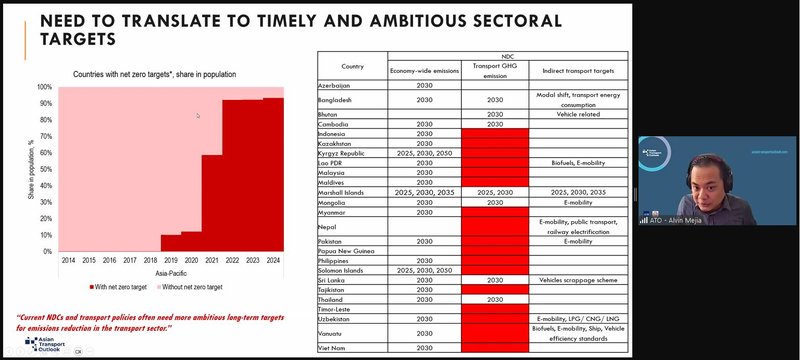
- Decarbonization as a Climate Blind Spot: Despite the sector's growth, freight decarbonization remains a blind spot in climate strategies. There's a lack of ambitious targets in existing policies, underscoring the need for more rigorous sectoral targets.
- Policy Instruments and Recommendations: Alvin emphasized the importance of adopting comprehensive (multi-scalar, multi-modal, multi-dimensional) policy instruments, including funding and financing, capacity building, and regulations, to accelerate the decarbonization process.
Adwait Limaye: "A Closer Look: Freight Dynamics in Asian Sub-regions"
Adwait Limaye from the Asian Transport Outlook presented an in-depth analysis of freight transport trends in Asian sub-regions, focusing on infrastructure, activity, and policy variations. Key points included:
- Growth in Freight Activity: There has been a rapid rise in domestic material consumption in Asia over the last two decades, fueling substantial growth in freight activity, particularly in South and South-West Asia.
- Transport Infrastructure Gap: However, transport infrastructure has not kept pace, raising concerns about a widening infrastructure gap.
- Activity and Services: Key areas discussed included the increase in heavy truck production, freight vehicle motorization, and trade, with projections pointing to a continued freight growth. Variations in freight vehicle motorization across different countries were highlighted, reflecting diverse levels of development and transport needs.
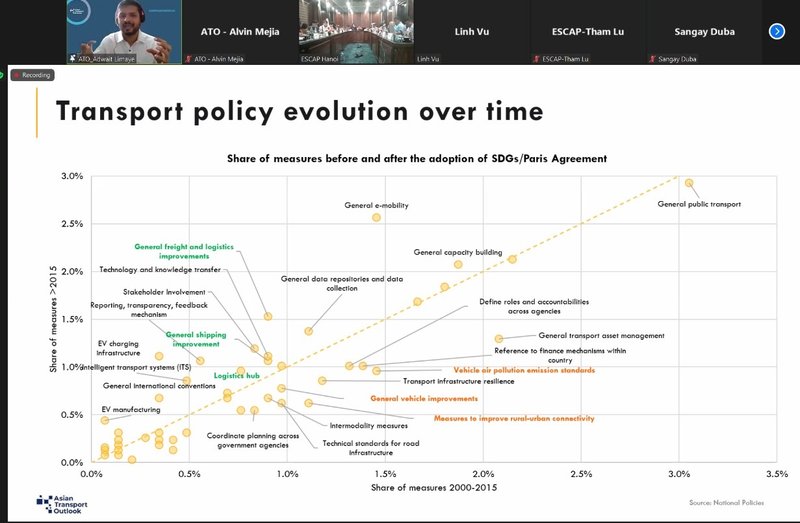
- Policy Measures: The presentation also highlighted a variety of policy measures with examples from ESCAP member countries and emphasized the need for translating these insights into robust, effective policies to ensure sustainable freight transport growth in the future.