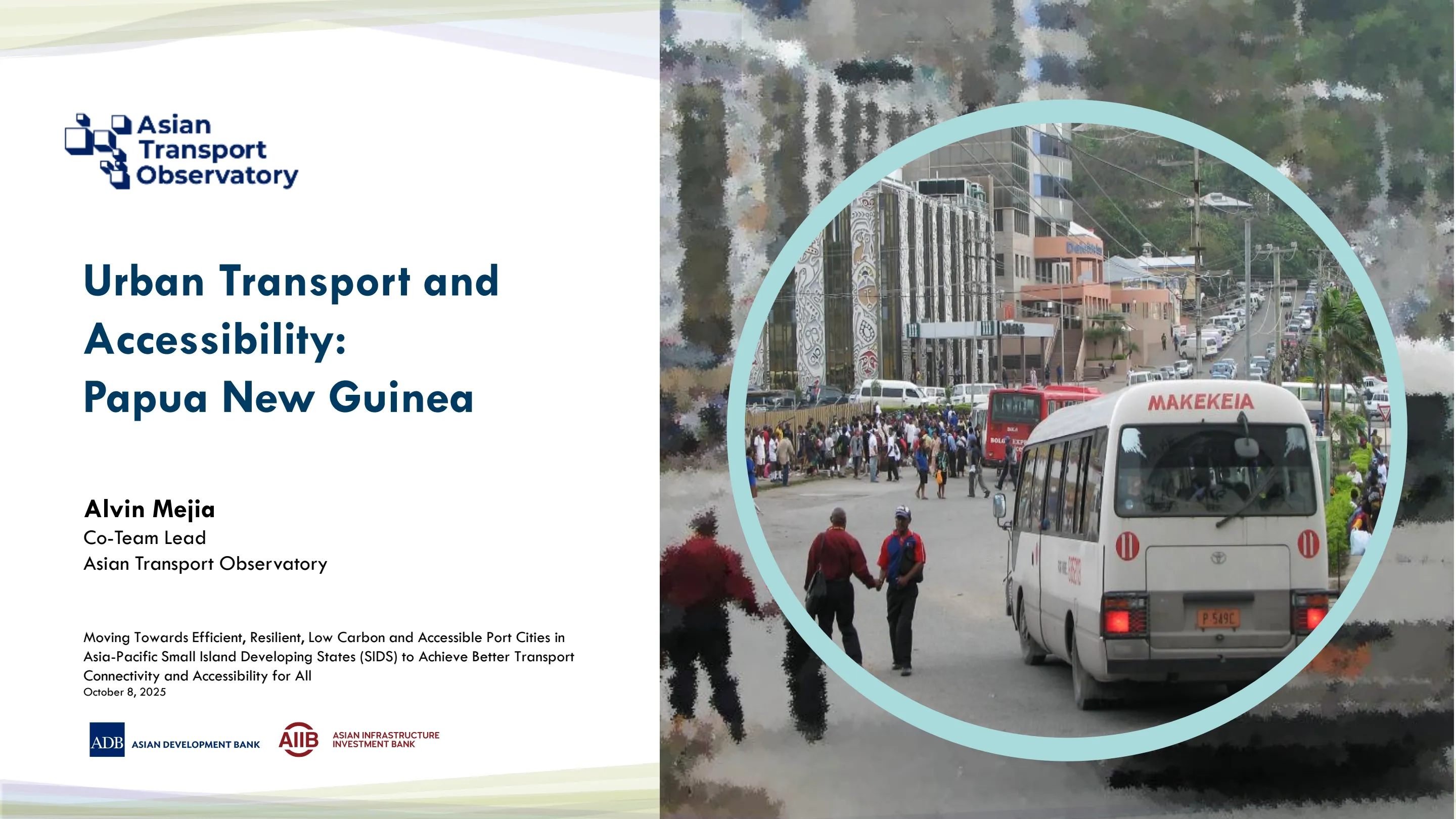
In early October, officials and experts gathered in Port Moresby to confront a familiar challenge for island nations—how to connect people and markets across land and sea without deepening carbon dependence. The National Workshop on Efficient, Resilient, Low-Carbon and Accessible Port Cities in Asia-Pacific Small Island Developing States (SIDS), hosted by ESCAP, set out to do just that.
Alvin Mejia, co-team lead of the Asian Transport Observatory (ATO), presented in the session on Data, Statistics, and Indicators held on the 8th of October. Drawing from ATO's regional database, he outlined how better data—on urbanization trends, infrastructure, and accessibility—can turn abstract sustainability pledges into measurable progress. His intervention anchored discussions on SUTI+, a new generation of transport indicators being piloted by ESCAP to capture social inclusion and accessibility gaps.
The workshop's focus on connectivity and inclusive mobility reflected a broader Pacific truth: transport determines who gets access to opportunity. ATO's contribution underscored that improving ports, roads, and data systems are not separate goals but pieces of the same puzzle—building efficient, resilient, and equitable connectivity in one of the world's most fragmented geographical region.
Cookies used on the site are categorized and below you can read about each category and allow or deny some or all of them. When categories than have been previously allowed are disabled, all cookies assigned to that category will be removed from your browser. Additionally you can see a list of cookies assigned to each category and detailed information in the cookie declaration.
Some cookies are required to provide core functionality. The website won't function properly without these cookies and they are enabled by default and cannot be disabled.
Analytical cookies help us improve our website by collecting and reporting information on its usage.
Cookies used on the site are categorized and below you can read about each category and allow or deny some or all of them. When categories than have been previously allowed are disabled, all cookies assigned to that category will be removed from your browser. Additionally you can see a list of cookies assigned to each category and detailed information in the cookie declaration.
Some cookies are required to provide core functionality. The website won't function properly without these cookies and they are enabled by default and cannot be disabled.
| Name | Hostname | Vendor | Expiry |
|---|---|---|---|
| sessionid | asiantransportobservatory.org | Asian Transport Observatory | 2 weeks |
|
Used by the website for authentication. |
|||
| csrftoken | asiantransportobservatory.org | Asian Transport Observatory | 24 hrs |
|
Used by website to protect CSRF vulnerable resources. |
|||
Analytical cookies help us improve our website by collecting and reporting information on its usage.
| Name | Hostname | Vendor | Expiry |
|---|---|---|---|
| _ga | .asiantransportobservatory.org | Google Analytics | 2 years |
|
Used by Google Analytics to distinguish users. |
|||
| _ga_Z5W4M9226H | .asiantransportobservatory.org | Google Analytics | 2 years |
|
Used by Google Analytics to to persist session state.. |
|||
| _clck | .asiantransportobservatory.org | Microsoft Clarity | 1 year |
|
Persists the Clarity User ID and preferences, unique to that site is attributed to the same user ID. |
|||
| _clsk | .asiantransportobservatory.org | Microsoft Clarity | 1 year |
|
Connects multiple page views by a user into a single Clarity session recording. |
|||
We use cookies to analyze our traffic. For these reasons, we may share your site usage data with our analytics partners.
By clicking "Allow All", you consent to store on your device all the technologies described in our
GDPR and Privacy Policy page.
You can update your cookie settings by visiting the 'Manage Cookies' link in the footer.