ATO Contributions to Advancing the Aichi 2030 Declaration at the EST Regional Meeting and Capacity Building Workshop
The Asian Transport Observatory (ATO) contributed to the EST Regional Meeting and Capacity-Building Workshop on Accelerating Implementation of the Aichi 2030 Declaration, held on 16–18 March 2026 in Bangkok, co-organized by UNDESA, UNCRD, UNESCAP, The Ministry of Environment of Japan, ADB and AIIB. The event brought together governments, development banks, and technical partners to bridge the gap between policy ambition and implementation, combining lead lectures, case-based learning, and group exercises to support countries in translating the Aichi 2030 goals into actionable strategies.
ATO's engagement spanned multiple sessions, linking data, policy, and practice across key themes of the Declaration. In Session 2, Alvin Mejia, Co-Team Lead of ATO, presented an overview of progress across EST member countries, highlighting emerging trends in transport decarbonization, resilience, air pollution, and safety. The analysis underscored early signs of decoupling between economic growth and transport emissions, alongside improvements in energy intensity and growing momentum in electrification—while also pointing to persistent gaps, including uneven progress across countries and the continued rise of certain emission sources.
These insights fed directly into Session 3, which focused on advancing low-carbon and resilient transport systems. Here, ATO's evidence base complemented technical inputs from development partners and country experiences, reinforcing the need to align climate mitigation, adaptation, and air quality strategies within a single policy framework. The session emphasized that while policy uptake has increased—particularly for climate resilience—implementation remains uneven, with infrastructure exposure to climate risks continuing to grow across the region.
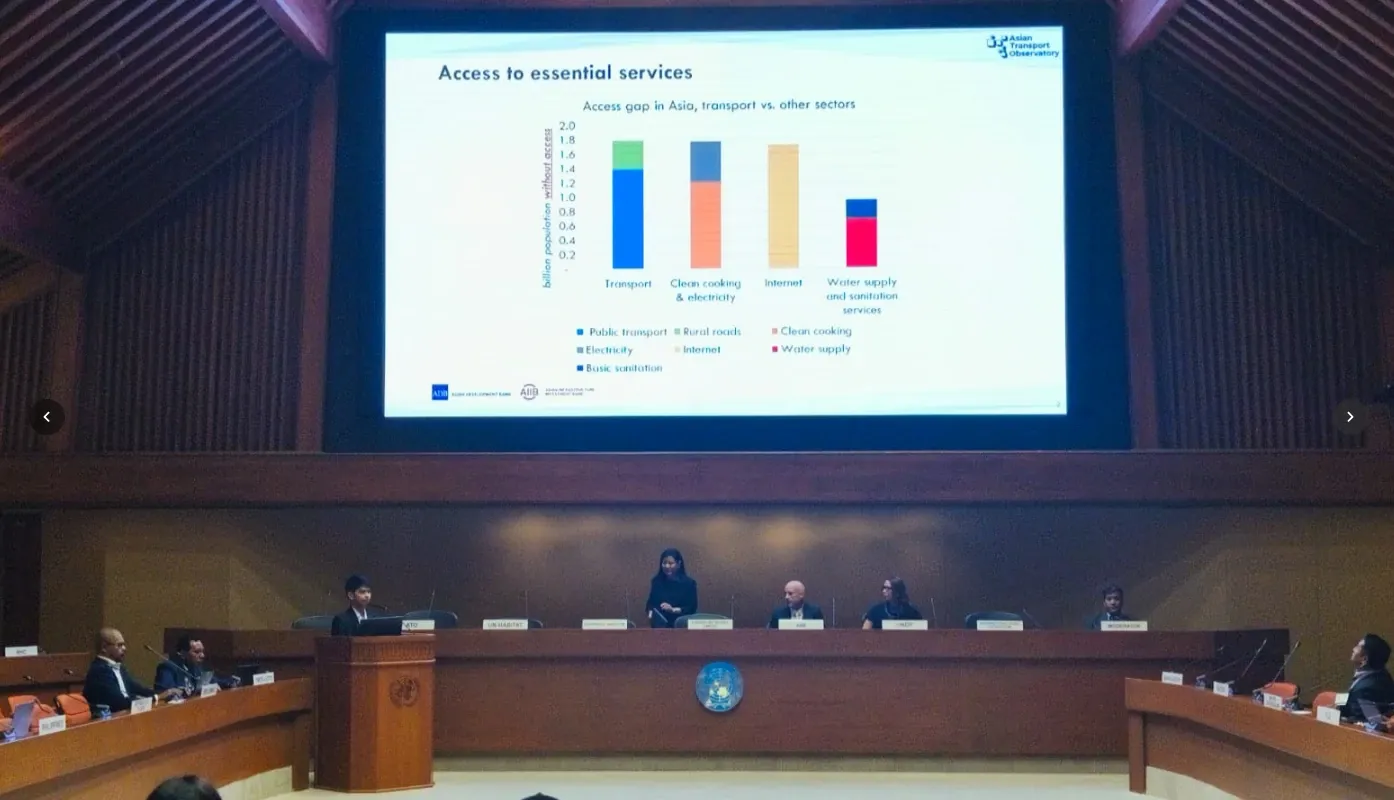
ATO also contributed to Session 5 on access and connectivity, where data-driven insights highlighted the scale of unmet mobility needs in Asia. The presentation by Aaron Salang, ATO Data Analyst showed that transport access gaps remain significant relative to other essential services, with disparities across urban and rural contexts and clear links to broader development outcomes. The session reinforced the importance of moving beyond infrastructure provision toward people-centered accessibility, integrating land use, service access, and inclusive mobility planning. The ATO team also contributed significantly in the conduct of the interactive workshops across the various sessions.
Across sessions, a consistent message emerged: data is no longer the constraint—its integration into decision-making is. The workshop’s structure—linking technical lectures with applied group exercises—demonstrated how countries can translate analytical insights into national strategies on decarbonization, resilience, connectivity, and logistics, while identifying bottlenecks and priority actions.
Building on these discussions, ATO will advance its role as the official monitoring mechanism of the Aichi 2030 Declaration through the development of a Mid-term Evaluation Report. This effort will synthesize country progress, identify gaps across the Declaration’s goals, and provide a clearer picture of where the region stands midway toward 2030. More importantly, it will aim to move beyond tracking—toward supporting implementation, by linking data, policy frameworks, and investment priorities in a more systematic way.
The workshop reaffirmed that achieving the Aichi 2030 goals will require not only stronger policies, but also continuous monitoring, peer learning, and institutional coordination. ATO's contribution—grounded in regional data and comparative analysis—positions it as a key platform in supporting this transition from ambition to action.