
Solomon Islands Green Roads Profile 2025
SOLOMON ISLANDS
GREEN ROADS PROFILE

Supported by:



The ATO green roads profiles present country-level perspectives on how 35 Asia-Pacific economies are addressing the development and management of sustainable eco-friendly roads. Drawing from diverse datasets and policy documents, the profiles highlight practices and measures that contribute to greener transport infrastructure.
Developed by the Asian Transport Observatory (ATO) in partnership with the International Road Federation (IRF), the profiles are designed to complement the Green Roads Toolkit. The toolkit provides a practical reference for integrating good practices across nine dimensions:
- Decarbonization
- Climate resilience
- Water and land management
- Pollution reduction
- Conserving biodiversity
- Responsible sourcing of materials
- Improving quality of life
- Disaster preparedness
- Fostering inclusive growth
This 2025 edition builds on earlier work to provide a comprehensive resource for guiding the planning, development, construction, and management of greener, more sustainable roads.
Background
Indicator - Dimension Matrix
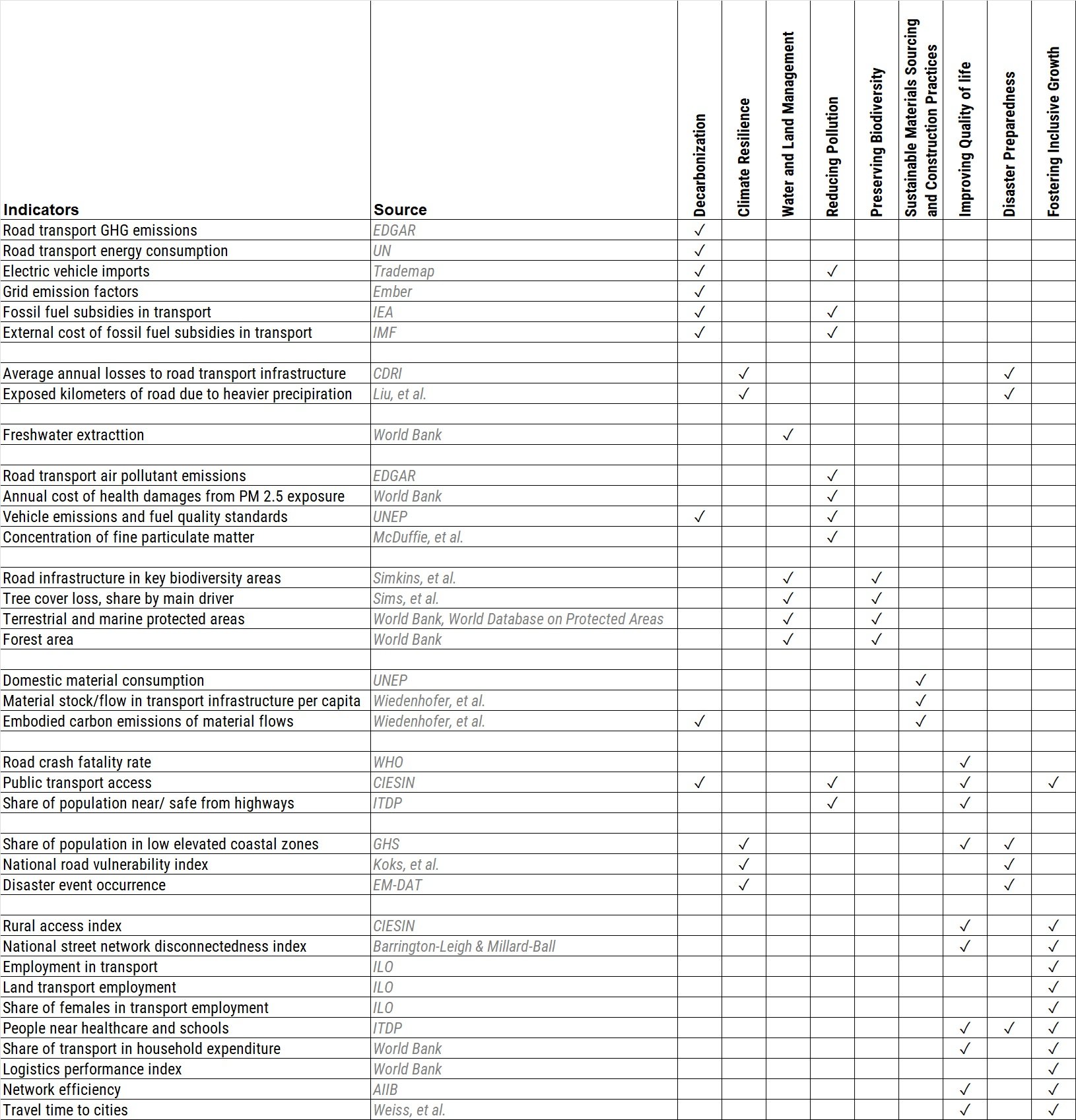
In the Solomon Islands, the concept of the ‘road network' differs strictly from the continental focus on high-speed motorways. Here, infrastructure is almost entirely defined by the ‘last mile.' The nation's 3,700-kilometer network consists exclusively of local and rural roads, with zero percent classified as motorways or primary highways. Official estimates classify 42% of the infrastructure as main roads, 35% as feeder roads, and 23% as access roads. Condition assessments confirm the decline. Of the 1,523 km core network, only 67% remains in maintainable condition . Some estimates indicate that, overall, only about 15 percent of the road network is deemed to be in fair to good condition. The remainder requires substantial rehabilitation. Causes are several, ranging from structural and historical factors to chronic funding deficits, ethnic tensions, and natural disasters, which have accelerated deterioration. Only 184 km of the main road network (12 percent of the overall network) is paved, with three-quarters of the sealed roads situated in Guadalcanal Province and Honiara City.
This unique topology shapes every aspect of the country's transport policy, from emissions profiles to climate vulnerability. The urgency of this transformation is driven by a motorization trajectory that has quietly outpaced regional peers. With 387 vehicles per thousand people, the Solomon Islands now exhibits a higher motorization rate than the Asia-Pacific average of 317. While this mobility supports local livelihoods, it has decoupled the transport sector from broader decarbonization trends. Since 2000, road transport greenhouse gas (GHG) emissions have climbed by 3.2% annually—nearly double the growth rate of economy-wide emissions. Today, road transport accounts for 86% of the nation's total transport emissions, signaling that any national climate strategy must prioritize the vehicular fleet.
Despite the growing fleet, the energy transition has yet to materialize. Between 2015 and 2024, electric vehicles (EVs) represented effectively 0% of total road vehicle imports. However, the foundational conditions for a shift are present. The UNEP E-mobility Readiness Index scores the country at 61 out of 100, suggesting that while policy and financial frameworks lag, the market potential exists. Accelerating this transition is not just an environmental obligation but a public health necessity. The economic cost of health damages from PM 2.5 exposure is estimated at roughly 13% of GDP, a staggering burden for a developing economy.
Yet, for an archipelago located in the Pacific Ring of Fire, mitigation is often overshadowed by the immediate demands of adaptation. The infrastructure stock—comprising some 26.7 million tonnes of material—is under constant siege. Since 2000, the islands have weathered 20 recorded natural disasters, half of which were storms. The financial implications are acute: the country faces average annual losses of roughly $327,600 to transport infrastructure, with road networks absorbing 83% of this damage. The National Road Vulnerability Index currently ranks the Solomon Islands 88th globally, highlighting the fragility of key segments where a single failure can sever essential supply chains.
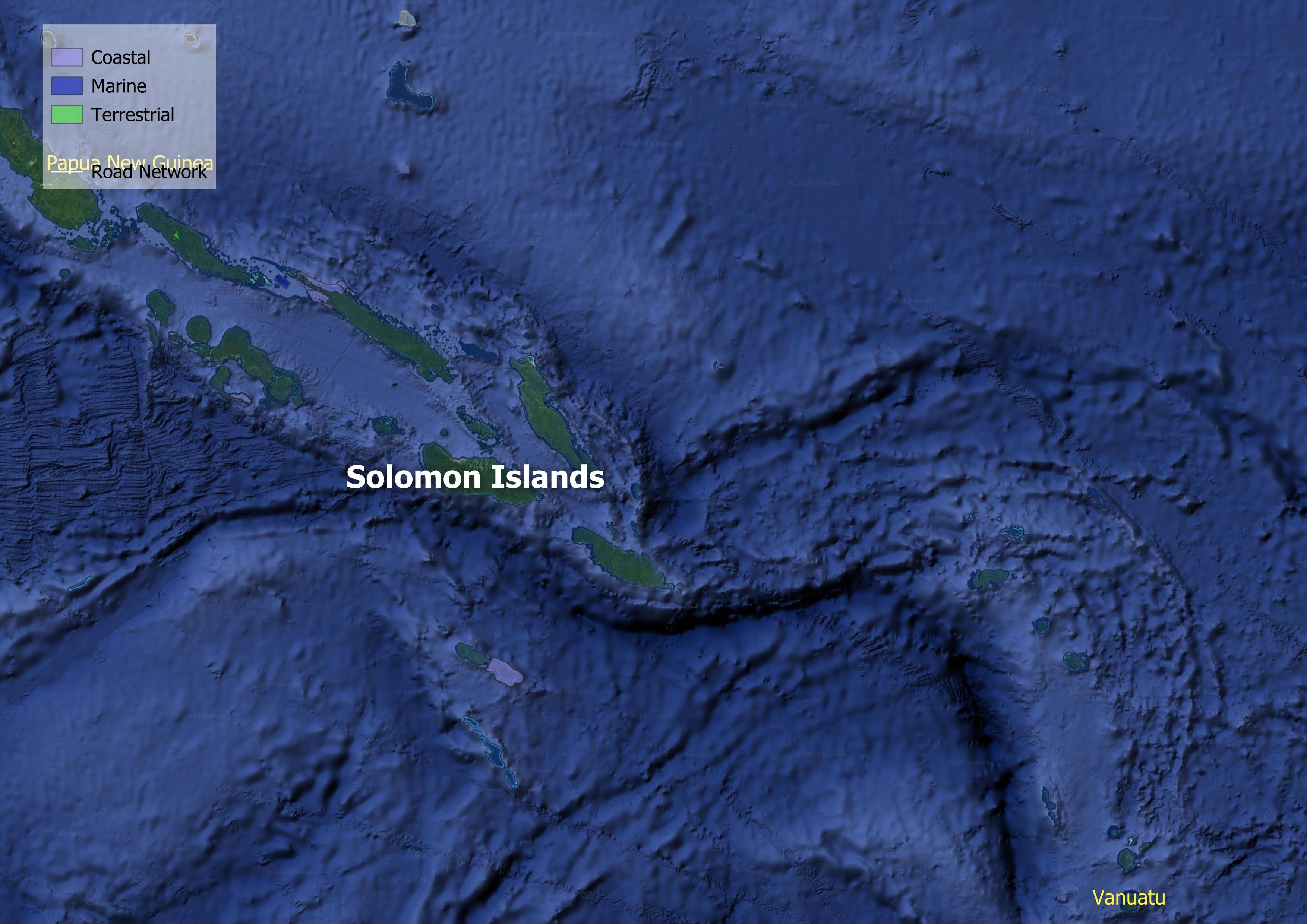
Building ‘Green Roads' also requires navigating a delicate ecological trade-off. With 90% of the land area forested, infrastructure expansion inevitably intersects with critical habitats. Research indicates that road infrastructure already encroaches upon 15 of the nation's 36 key biodiversity areas. The density of roads within these sensitive zones stands at 17 meters per square kilometer. Future development requires rigorous spatial planning to ensure that the drive for connectivity does not cannibalize the natural capital that sustains local communities.
Ultimately, the metric of success for the Solomon Islands is social inclusion. The current deficit is significant: 240,000 rural residents live beyond the reach of all-season roads, effectively isolating a significant portion of the population from healthcare, education, and markets. This isolation is compounded by a lack of public transit options; in urban agglomerations, only two out of ten residents have access to public transport. Furthermore, the sector itself remains heavily gender-imbalanced, with women comprising only 7.3% of the transport workforce.
Transport investment in the Solomon Islands faces challenges due to its size and spread: a small population scattered across about 90 inhabited islands leads to high unit costs, making every kilometer of infrastructure disproportionately expensive to build and maintain. A transition to Green Roads in the Solomon Islands demands a dual-track approach: hardening existing assets against the certainty of climate shocks while decarbonizing the vehicle fleet that relies on them. It requires shifting the focus from simple road density to network resilience and inclusive access. Investments must pivot toward adaptation to reduce the annual material loss of 503,000 tonnes currently spent on maintenance and expansion. Simultaneously, fiscal policy must address the external costs of fossil fuels—currently manifesting as congestion, road damage, and health burdens—to incentivize the uptake of electric mobility. Only through such an integrated strategy can the road network evolve from a source of emissions and vulnerability into a resilient backbone for sustainable island development. The nation has established planning frameworks; execution, including financing, remains a challenge.
Decarbonization
Climate Resilience
Water and Land Management
Reducing Pollution
Preserving Biodiversity
Sustainable Materials Sourcing and Construction Practices
Improving Quality of life
Disaster Preparedness
Fostering Inclusive Growth
Supporting Information
Road Infrastructure Pipeline
| East Guadalcanal Bridges | 2017 | 50 million SBD | None |
| Honiara East–West Inner Bypass (EW Link) | 2017 | None | 27 |
| Honiara Outer Ring Road | 2017 | None | None |
| Land and Maritime Connectivity Project | 2021 | 170.71 million USD | 35 |
| Land and Maritime Connectivity Project (Tranche 1) | 2021 | 49.15 million USD | 35 |
| Land and Maritime Connectivity Project (Tranche 2) | 2024 | 61.52 million USD | 35 |
| National Bridge Improvement Program | 2017 | 234 million SBD | None |
| National Bridge Improvement Program (EQPSIP) | 2017 | None | None |
| Resealing of Honiara Feeder Roads | 2020 | 30 million SBD | None |
| Second Solomon Islands Roads and Aviation Project | 2022 | 89.21 million USD | None |
| Second Solomon Islands Roads and Aviation Project - Additional Financing | 2025 | 40 million USD | None |
| South Malaita Bridges – Phase 3 | 2017 | 23 million SBD | None |
Unit Cost Road Projects
Road Transport Policy Landscape
Road Transport Policy Targets
| Solomon Islands Priority Infrastructure Investment Pipeline | 2035 | The NDS determines that, by 2035, at least 40% of Solomon Islanders in rural areas should have access to essential services as a direct result of the rehabilitation and construction of new roads, bridges, and wharves. |
Road Transport Policy Measure Types
References
AIIB. (n.d.). MEASURING TRANSPORT CONNECTIVITY FOR TRADE IN ASIA. https://impact.economist.com/perspectives/sites/default/files/eco141_aiib_transport_connectivity_4.pdf/
Asian Transport Observatory. (2025). Asia and the Pacific's Transport Infrastructure and Investment Outlook 2035. https://asiantransportobservatory.org/analytical-outputs/asia-transport-infrastructure-investment-needs/
Barrington-Leigh, C., & Millard-Ball, A. (2025). A high-resolution global time series of street-network sprawl. https://journals.sagepub.com/doi/10.1177/23998083241306829
CDRI. (2023). Global Infrastructure Risk Model and Resilience Index. https://giri.unepgrid.ch/
CIESIN. (2023a). Rural Access Index [Dataset]. https://sedac.ciesin.columbia.edu/data/set/sdgi-9-1-1-rai-2023
CIESIN. (2023b). SDG Indicator 11.2.1: Urban Access to Public Transport, 2023 Release: Sustainable Development Goal Indicators (SDGI). https://sedac.ciesin.columbia.edu/data/set/sdgi-11-2-1-urban-access-public-transport-2023
EDGAR. (2025). GHG emissions of all world countries: 2025. Publications Office. https://data.europa.eu/doi/10.2760/9816914
Ember. (2024). Electricity Data Explorer [Dataset]. https://ember-energy.org/data/electricity-data-explorer
EM-DAT. (2025). EM-DAT - The international disaster database. https://www.emdat.be/European Commission. (2024). Global Air Pollutant Emissions EDGAR v8.1 [Dataset]. https://edgar.jrc.ec.europa.eu/dataset_ap61#sources
IEA. (n.d.). Fossil Fuel Subsidies. IEA. Retrieved April 19, 2025, from https://www.iea.org/topics/fossil-fuel-subsidies
ILO. (2025). ILOSTAT [Dataset]. https://rplumber.ilo.org/files/website/bulk/indicator.html
ITDP. (2024). The Atlas of Sustainable City Transport. https://atlas.itdp.org/
Koks, E., Rozenberg, J., Tariverdi, M., Dickens, B., Fox, C., Ginkel, K. van, & Hallegatte, S. (2023). A global assessment of national road network vulnerability. Environmental Research: Infrastructure and Sustainability, 3(2), 025008. https://doi.org/10.1088/2634-4505/acd1aa
Liu, K., Wang, Q., Wang, M., & Koks, E. E. (2023). Global transportation infrastructure exposure to the change of precipitation in a warmer world. Nature Communications, 14(1), 2541. https://doi.org/10.1038/s41467-023-38203-3
McDuffie, E. E., Martin, R. V., Spadaro, J. V., Burnett, R., Smith, S. J., O'Rourke, P., Hammer, M. S., van Donkelaar, A., Bindle, L., Shah, V., Jaeglé, L., Luo, G., Yu, F., Adeniran, J. A., Lin, J., & Brauer, M. (2021). Source sector and fuel contributions to ambient PM2.5 and attributable mortality across multiple spatial scales. Nature Communications, 12(1), 3594. https://doi.org/10.1038/s41467-021-23853-y
Parry, S. B., Antung A. Liu,Ian W. H. (2023). IMF Fossil Fuel Subsidies Data: 2023 Update. IMF. https://www.imf.org/en/publications/wp/issues/2023/08/22/imf-fossil-fuel-subsidies-data-2023-update-537281
Simkins, A. T., Beresford, A. E., Buchanan, G. M., Crowe, O., Elliott, W., Izquierdo, P., Patterson, D. J., & Butchart, S. H. M. (2023). A global assessment of the prevalence of current and potential future infrastructure in Key Biodiversity Areas. Biological Conservation, 281, 109953. https://doi.org/10.1016/j.biocon.2023.109953
Sims, M., Stanimirova, R., Neumann, M., Raichuk, A., & Purves, D. (2025). New Data Shows What's Driving Forest Loss Around the World. https://www.wri.org/insights/forest-loss-drivers-data-trends
Trademap. (2025). Trade Map. Trade Map. https://www.trademap.org/Index.aspx
UN DESA. (n.d.). Economic and Environmental Vulnerability Indicators. Retrieved January 26, 2026, from https://policy.desa.un.org/themes/least-developed-countries-category/ldc-identification-criteria-indicators/evi-indicators
UN DESA. (2025). 2024 Revision of World Population Prospects. https://population.un.org/wpp/
UN Energy Statistics. (2025). Energy Balance Visualization [Dataset]. https://unstats.un.org/unsd/energystats/dataPortal/
UNEP. (2021, May 12). Domestic material consumption (DMC) and DMC per capita, per GDP (Tier I). https://www.unep.org/indicator-1222
Weiss, D. J., Nelson, A., Gibson, H. S., Temperley, W., Peedell, S., Lieber, A., Hancher, M., Poyart, E., Belchior, S., Fullman, N., Mappin, B., Dalrymple, U., Rozier, J., Lucas, T. C. D., Howes, R. E., Tusting, L. S., Kang, S. Y., Cameron, E., Bisanzio, D., … Gething, P. W. (2018). A global map of travel time to cities to assess inequalities in accessibility in 2015. Nature, 553(7688), 333-336. https://doi.org/10.1038/nature25181
WHO. (2023). Global Status Report on Road Safety 2023. https://www.who.int/teams/social-determinants-of-health/safety-and-mobility/global-status-report-on-road-safety-2023
Wiedenhofer, D., Baumgart, A., Matej, S., Virág, D., Kalt, G., Lanau, M., Tingley, D. D., Liu, Z., Guo, J., Tanikawa, H., & Haberl, H. (2024). Mapping and modelling global mobility infrastructure stocks, material flows and their embodied greenhouse gas emissions [Dataset]. https://doi.org/10.1016/j.jclepro.2023.139742
World Bank. (2021). ICP 2021. https://databank.worldbank.org/source/icp-2021
World Bank. (2022a). Annual freshwater withdrawals, total (% of internal resources) [Dataset]. https://data.worldbank.org
World Bank. (2022b). Land area (sq. Km) [Dataset]. https://data.worldbank.org
World Bank. (2022c). The Global Health Cost of PM2.5 Air Pollution: A Case for Action Beyond 2021. The World Bank. https://doi.org/10.1596/978-1-4648-1816-5
World Bank. (2023). Forest area (% of land area) [Dataset]. https://data.worldbank.org/indicator/AG.LND.FRST.ZS
World Bank. (2024). Home | Logistics Performance Index (LPI). Logistics Performance Index. https://lpi.worldbank.org/
World Bank. (2025a). GDP per capita, PPP (current international $) [Dataset]. https://data.worldbank.org/indicator/NY.GDP.PCAP.PP.CD
World Bank. (2025b). GDP, PPP (current international $) [Dataset]. https://data.worldbank.org/indicator/NY.GDP.MKTP.PP.CD
World Database on Protected Areas. (2024). Protected Areas (WDPA) [Dataset]. https://www.protectedplanet.net/en/thematic-areas/wdpa?tab=WDPA