
People's Republic of China Green Roads Profile 2025
PEOPLE'S REPUBLIC OF CHINA
GREEN ROADS PROFILE

Supported by:


The ATO green roads profiles present country-level perspectives on how 35 Asia-Pacific economies are addressing the development and management of sustainable eco-friendly roads. Drawing from diverse datasets and policy documents, the profiles highlight practices and measures that contribute to greener transport infrastructure.
Developed by the Asian Transport Observatory (ATO) in partnership with the International Road Federation (IRF), the profiles are designed to complement the Green Roads Toolkit. The toolkit provides a practical reference for integrating good practices across nine dimensions:
- Decarbonization
- Climate resilience
- Water and land management
- Pollution reduction
- Conserving biodiversity
- Responsible sourcing of materials
- Improving quality of life
- Disaster preparedness
- Fostering inclusive growth
This 2025 edition builds on earlier work to provide a comprehensive resource for guiding the planning, development, construction, and management of greener, more sustainable roads.
Background
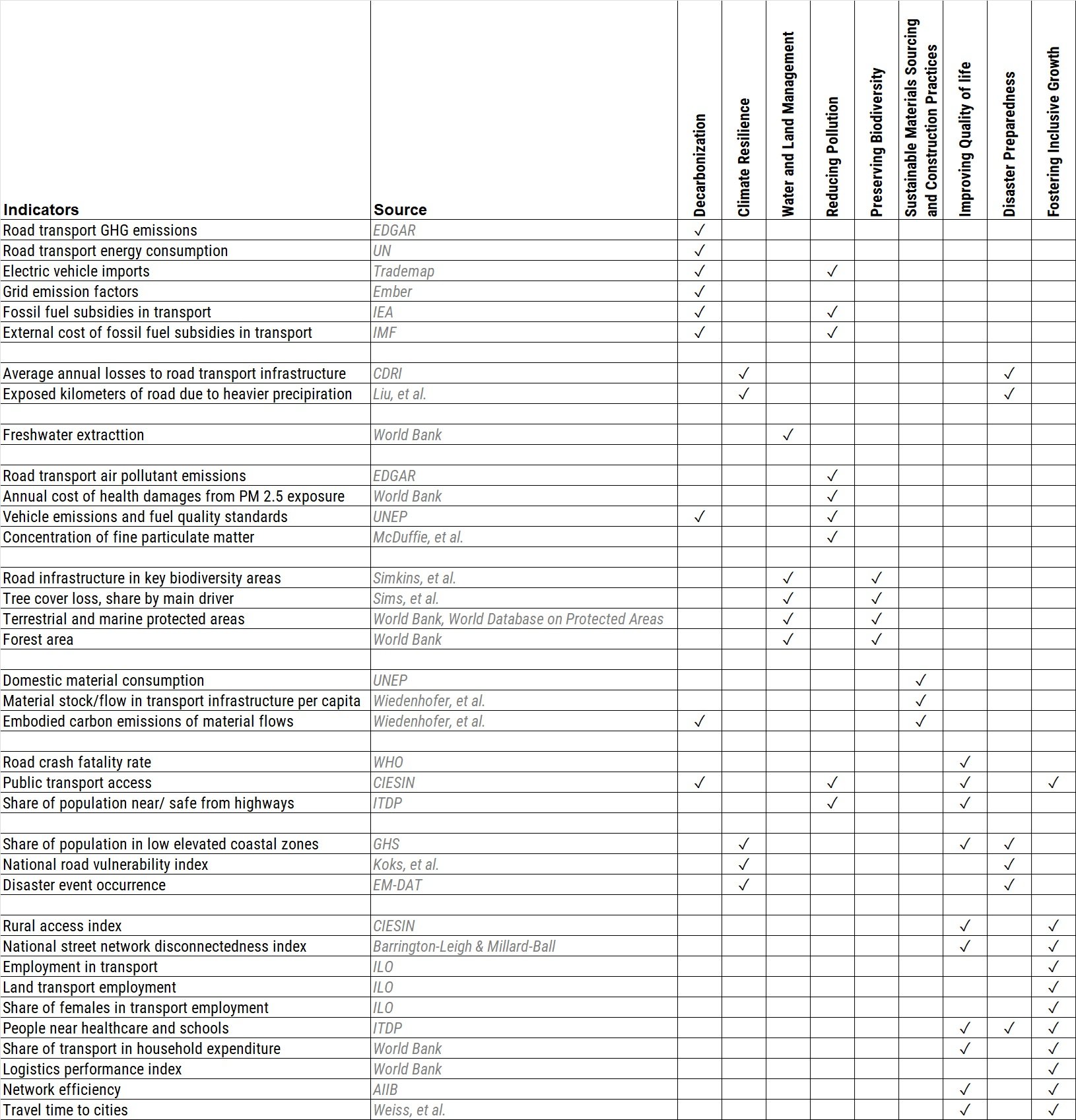
Indicator - Dimension Matrix
The road network in the People's Republic of China reflects the country's rapid economic growth, covering 5.6 million kilometers. About 59% of these roads are local and rural, leading into a main arterial system making up 17% of the total. In 2000, there were 2.3 kilometers of roads per thousand people, increasing to 4.0 by 2024. The asphalt infrastructure has expanded to accommodate users. Motor vehicle numbers have risen to 313 vehicles per thousand residents, nearing the Asia-Pacific average of 317. However, the vehicle mix remains distinct: two-wheelers constitute 59% of users, and light-duty vehicles (LDVs) account for 35%. This indicates an active, ongoing mobility shift that is still evolving and heavily contested by limited space.
The sector's emissions profile is heavy. Road transport generated 774.4 million tonnes of CO2 equivalent (CO2e) in 2024. This volume represents 81% of total transport emissions and 5% of the economy-wide total. The trajectory is concerning. Since 2000, road transport emissions expanded by 6.0% annually. This outpaces the broader economy, where emissions grew at 4.8%. The sector is becoming a carbon laggard relative to national industrial gains. However, efficiency has improved. The intensity of emissions relative to GDP fell from 53 grams of CO2e per USD in 1990 to 20 in 2024.
China faces growing challenges in safeguarding the performance and longevity of transport infrastructure as climate change amplifies environmental and geotechnical risks across key development corridors. For example, permafrost in China covers about 1.59 million km², with two-thirds located on the Qinghai-Tibet Plateau, where a large share is warm, ice-rich, and thermally unstable. Ongoing climate warming is accelerating permafrost degradation—thickening the active layer and increasing risks of settlement and damage to highways and other linear infrastructure (Wang et al. 2020).
The PRC has heavily invested in electrification to sever the traditional link. From 2015 to 2024, electric vehicle (EV) imports reached a total of $21.3 billion USD. The trend is clear: nearly half of China's car sales in 2024 were electric, accounting for nearly two-thirds of global electric car sales. In that year, China's electric car sales grew by nearly 40% year-over-year, boosting its share in the global market. In 2021, China represented 50% of worldwide electric car sales; this increased to almost 66% in 2024. Since July 2024, electric car sales have surpassed traditional car sales each month, reaching close to 50% of total car sales for the year.
Yet, an EV is only as clean as the grid that feeds it. The grid emission factor in the PRC is 555 gCO2 per kWh. This is a marginal improvement over the regional average of 559, but it remains high. UNEP's E-mobility Readiness Index scores the country at 91 out of 100, reflecting strong policy and market preparation.
The infrastructure faces a hostile climate. The country absorbs estimated annual losses of 19.3 billion USD to transport infrastructure due to natural hazards. This loss equals 0.054% of GDP. Roads account for 46% of this damage. Bridges and tunnels, though a fraction of the network length (2.9%), absorb a disproportionate 38.7% of the financial shock. The future threatens higher costs. Under a 4.5-degree warming scenario, over 65% of road and rail assets face exposure to intensified precipitation.
Access remains unequal. In urban agglomerations, the connection between residence and transit is fractured. Only 14% of these urban centers provide public transport access to half their population within 500 meters. In 65% of cities, only two out of ten residents have such access. The Institute for Transportation and Development Policy estimates that only 40% of the urban population lives at a safe distance from highways. The road brings mobility, but it also brings severance and risk. In the hinterlands, the gap is physical. 78.4 million rural residents remain beyond the reach of an all-season road. They are cut off from the market and the clinic. The Logistics Performance Index ranking improved to 19 in 2023, signaling efficiency for freight.
The public health burden is significant. The World Bank estimates the cost of health damages from PM 2.5 exposure at roughly 13% of GDP. Road transport contributes 9% of these particulates. This pollution, combined with ozone, led to at least 115,500 premature deaths. Safety remains another crisis. WHO estimates 248,099 road crash fatalities in 2021. In People's Republic of China, road crash fatalities decreased by approximately -1% per year between 2016 and 2021. However, this is not enough to reach the 2030 target to halve the fatalities by 2030.
The data reveals a challenge: emissions are rising more quickly than the economy. Despite high density, urban access remains unexpectedly limited, and millions still face rural isolation. The fast expansion of networks and the bold move toward electrification are technologically remarkable and motivated by policy.
Decarbonization
Climate Resilience
Water and Land Management
Reducing Pollution
Preserving Biodiversity
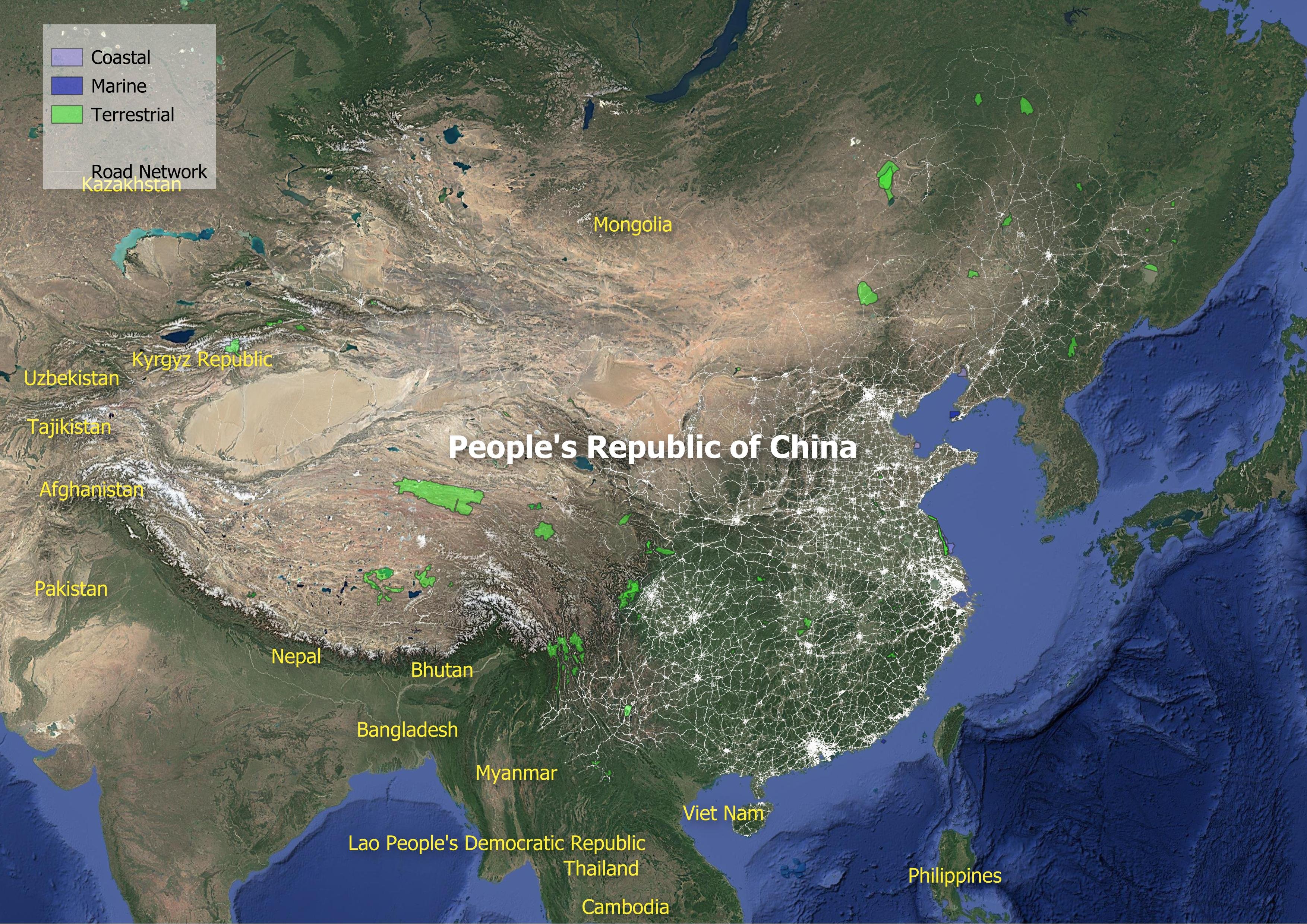
Sustainable Materials Sourcing and Construction Practices
Improving Quality of life
Disaster Preparedness
Fostering Inclusive Growth
Supporting Information
Road Infrastructure Pipeline
| China: Guangxi Chongzuo Border Connectivity Improvement Project | 2021 | None | None |
| G1 Jingha Expressway Suizhong–Panjin Widening Project | None | 3170 million CNY | 238.2 |
| G15 Shenhai Expressway (He'ao to Shenzhen Airport Section) Expansion Project | None | None | 41 |
| G15 Shenhai Expressway Quanzhou–Xiamen Section Expansion | None | 3420 million CNY | 82 |
| G4 Beijing–Hong Kong–Macau Expressway (Guangzhou–Shenzhen Section) Expansion Project | None | 21433 million CNY | None |
| G4216 Yibin (Xinshi)–Panzhihua Expressway (Ya–Pan Riverside Highway) | 2017 | 9343.1 million CNY | 446.2 |
| G7611 (Duyun–Shangri-La Expressway) Zhaotong–Shangri La Section | None | None | None |
| Jilin Yanji Low-Carbon Climate-Resilient Healthy City Project | 2019 | 259.79 million USD | None |
| Low Carbon Transition of Urban Mobility in Yichang (Hubei) | 2024 | 3624.99994 million USD | None |
Unit Cost Road Projects
Road Transport Policy Landscape
Road Transport Policy Targets
| Five-Year Action Plan to Accelerate the Construction of a Strong Transportation Nation (2023-2027) | 2027 | Accelerate the implementation of projects such as the renovation of dangerous and old bridges (including the construction of structural health monitoring systems for long bridges), the refinement of safety facilities, and disaster prevention and control. The treatment rate of newly discovered Class IV and Class V bridges on national and provincial trunk roads reached 100%, and no less than 1,000 kilometers of trunk road disaster prevention and control were completed each year. |
| Five-Year Action Plan to Accelerate the Construction of a Strong Transportation Nation (2023-2027) | 2027 | Promote the revision of laws such as the Highway Law. Accelerate the revision of administrative regulations such as the the Regulations on Urban Public Transportation, the Regulations on the Management of Toll Highways, the Regulations on Road Transport, the Regulations on Rural Highways. |
| Action Plan on Demonstrating and Promoting the Use of Shore Power by Container Ships and Cruise Ships on International Routes at Ports (2023-2025) | 2025 | Before the end of 2025, the demand (capacity) electricity fee will be waived for port shore power operators that implement a two-part electricity price. We will encourage local governments to introduce financial support policies for the construction and use of port and ship shore power. In principle, the comprehensive cost of shore power use (electricity charges + service fees) should not be higher than the ship fuel cost before the end of 2025, and we will promote the normalization of the use of shore power by ships in the jurisdiction when they are docked. |
| Guiding Opinions on Promoting the Integrated Development of Transportation and Energy | 2030 | Before 2030, the demand (capacity) electricity fee will be waived for centralized charging (swapping) facilities that implement a two-part electricity price. |
| Action Plan for Reducing Costs, Improving Quality and Increasing Efficiency of Transportation and Logistics | 2027 | By 2027, the cost reduction, quality improvement and efficiency improvement of transportation and logistics will achieve remarkable results, and the ratio of total social logistics costs to GDP will be reduced to about 13.5%. The national railway freight transportation turnover will increase by about 10% compared with 2023. the port container rail-water transport volume will increase by about 15% annually, and the reform of the comprehensive transportation system will make major breakthroughs. |
| Five-Year Action Plan to Accelerate the Construction of a Strong Transportation Nation (2023-2027) | 2027 | By 2027, a modern commercial circulation system that connects the inside and outside, connects urban and rural areas, connects production and sales, and is efficient and smooth will be basically established. The urban and rural commercial circulation network will be more complete, a hierarchical and classified urban commercial layout will be constructed, and the three-level logistics distribution system of counties, towns and villages will be improved. The cold chain circulation rates of fruits and vegetables and meat will reach 25% and 45% respectively. Improve the three-level logistics distribution system of counties, towns and villages. Encourage the integration of rural logistics, e-commerce and commercial circulation, supply and marketing distribution, postal express and other facilities, promote the integrated development of passenger, freight and postal services, and vigorously develop joint distribution. Support the integration of rural stores, rural comprehensive service agencies, and village-level express logistics comprehensive service stations (village post stations) into one, one network for multiple uses, and improve comprehensive service capabilities. Develop cold chain logistics for agricultural products. Build and transform regional cold chain logistics bases, integrate processing, distribution, low-temperature distribution and other functions, and strengthen the connection between trunk and branch cold chain logistics. Develop third-party cold chain logistics. Develop fresh food e-commerce and chain vegetable stores, improve cold chain facilities such as urban distribution warehouses and community forward warehouses, and improve intra-city distribution capabilities. |
| Green Transportation "14th Five-Year" Development Plan | 2025 | New energy and clean energy container trucks account for 60% of international container hubs and seaports. Further accelerate the promotion of "road to rail" and "road to water" in ports and large industrial and mining enterprises. The proportion of ore and coke transported by rail, water, closed belt corridors and new energy vehicles in major coastal ports in Beijing, Tianjin, Hebei and surrounding areas reaches more than 70%. The proportion of green transportation of coal, ore, coke and other large industrial and mining enterprises with dedicated railway lines in the main coal producing areas of Shanxi, Shaanxi and Inner Mongolia has been greatly increased, and the proportion of railway transportation of coal and coke with a transportation distance of more than 500 kilometers out of the province will strive to reach more than 80%. Urban green freight distribution demonstration projects. We will deepen the creation of urban green freight distribution demonstration projects, and by 2025, we will orderly build about 100 urban green freight distribution demonstration projects. |
| Guiding Opinions on Accelerating the Integration of Passenger, Freight and Postal Services in Rural Areas | 2027 | We will strive to achieve full coverage of rural passenger, freight and postal integrated development in county-level administrative regions that meet the conditions by 2027, with the number of integrated stations of passenger, freight and postal at the county, township and village levels reaching more than 100,000, and rural passenger, freight and postal cooperation routes reaching more than 20,000. We will basically establish a new rural transportation service model of "multiple functions at one point, multiple uses on one network, intensive functions, convenience and efficiency", significantly improve the national rural transportation service level and sustainable development capabilities, and significantly enhance the people's sense of gain, happiness and security. |
| Outline for Building a Strong Transportation Nation | 2035 | By 2035, the "Global 123 Express Logistics Circle" (domestic delivery in 1 day, delivery to neighboring countries in 2 days, and delivery to global major cities in 3 days) will be basically formed, and multimodal transport of goods will be efficient and economical. |
| Planning Outline of National Comprehensive Three-dimensional Transportation Network (2021-2035) | 2035 | By 2035, the the national comprehensive three-dimensional transportation network facilities will be more efficient. The proportion of multimodal transport and transshipment efficiency will be significantly improved, the transportation structure will be further optimized, and the logistics costs will be further reduced. The transportation hubs basically have the function of postal delivery, and achieve seamless connection with postal delivery hubs. "Global 123 Express Logistics Circle" will be basically achieved. (1-day delivery in China, 2-day delivery in neighboring countries, 3-day delivery in major cities around the world) |
| Planning Outline of National Comprehensive Three-dimensional Transportation Network (2021-2035) | 2035 | 1-hour completion rate of multimodal transport transshipment: More than 90%. |
| 2024 Work Plan for Five People's Livelihood Matters, including Expansion, Improvement and Efficiency of Accessible Transportation Services for the Elderly | 2024 | Expand the coverage of taxi call or online car-hailing "one-click call" service, and basically achieve full coverage of cities at prefecture level and above. Accelerate the promotion and application of low-floor and low-entry urban public buses and trams, and build 500 new urban public bus and tram lines that respect and love the elderly. Create 20 urban rail transit operation service brand lines, optimize the station and train environment, promote the optimization and transformation of entrances and exits and transfer facilities, and provide a safe, convenient and warm riding environment and services for various groups including the elderly. |
| Green Transportation "14th Five-Year" Development Plan | 2025 | New energy and clean energy container trucks account for 60% of international container hubs and seaports. Further accelerate the promotion of "road to rail" and "road to water" in ports and large industrial and mining enterprises. The proportion of ore and coke transported by rail, water, closed belt corridors and new energy vehicles in major coastal ports in Beijing, Tianjin, Hebei and surrounding areas reaches more than 70%. The proportion of green transportation of coal, ore, coke and other large industrial and mining enterprises with dedicated railway lines in the main coal producing areas of Shanxi, Shaanxi and Inner Mongolia has been greatly increased, and the proportion of railway transportation of coal and coke with a transportation distance of more than 500 kilometers out of the province will strive to reach more than 80%. Urban green freight distribution demonstration projects. We will deepen the creation of urban green freight distribution demonstration projects, and by 2025, we will orderly build about 100 urban green freight distribution demonstration projects. |
| National Highway Network Plan | 2035 | The National Roads network effectively avoids ecological protection areas and environmentally sensitive areas, significantly improves the efficiency of land space utilization, and basically achieves greening of the entire process and cycle of construction. |
| Action plan to promote large-scale equipment renewals and consumer product trade-ins | 2027 | By 2027, the scale of equipment investment in industry, agriculture, construction, transportation, education, culture and tourism, and medical care will increase by more than 25% compared with 2023. |
| 14th Five Year Plan for Aviation Logistics | 2025 | Service capabilities are smart and advanced. The level of information and intelligent application of aviation logistics has been significantly improved, the electronic rate of freight documents has reached 80%, and electronic waybills have been promoted and applied in major airports across the country. |
| 14th Five-Year Plan | 2025 | Promote the construction of about 120 national logistics hubs. |
| Five-Year Action Plan to Accelerate the Construction of a Strong Transportation Nation (2023-2027) | 2027 | Five global international postal express hub clusters have been basically built. The level of integration, intensiveness and complexity of comprehensive transportation hubs has been significantly improved, with the railway access rate to major coastal ports exceeding 95% and the rail transit access rate to hub airports exceeding 80%. Improve the rural logistics service network, publicize and promote 100 rural logistics service brands across the country, and improve the level of logistics services in rural areas. |
| Guiding Opinions on Accelerating the Integration of Passenger, Freight and Postal Services in Rural Areas | 2027 | By 2027, the number of integrated stations of passenger, freight and postal at the county, township and village levels reaching more than 100,000. |
| "14th Five-Year Plan" Development Plan for Comprehensive Transportation Services | 2025 | By 2025, a total of about 200 demonstration counties for urban-rural transportation integration will be built across the country. |
| Five-Year Action Plan to Accelerate the Construction of a Strong Transportation Nation (2023-2027) | 2027 | Carry out the creation of about 200 demonstration counties for integrated urban and rural transportation. |
| Action Plan to Effectively Reduce Logistics Costs in the Whole Society | 2027 | by 2027, the ratio of total social logistics costs to GDP will be reduced to about 13.5%. |
| 14th Five Year Development Plan for Highways | 2025 | Highways will be extended to all cities and counties with an urban population of over 100,000, and the main routes of the “71118” national expressway network will be essentially completed. Remaining gaps in ordinary national highways and other pending sections will be largely eliminated. (*“71118” refers to national network consisting of 7 radial expressways from the capital, 11 north-south vertical expressways, and 18 east-west horizontal expressways.) |
| 14th Five-Year Plan Modern Comprehensive Transportation System Development Plan | 2025 | The main lines of the national expressway network composed of 7 capital radial lines, 11 north-south longitudinal lines, 18 east-west horizontal lines, and regional ring lines, parallel lines, and connecting lines are basically connected, and the quality of ordinary roads is further improved. The national highways along the border are basically connected. The mileage of open roads is 5.5 million kilometers, of which 190,000 kilometers are expressways. Accelerate the upgrading and quality improvement of low-grade sections of general national and provincial highways, and increase the proportion of Class II or above national highways in western regions to 70%." "Improve the high-quality development system for 'Four Good Rural Roads' and carry out demonstration programs in depth, aiming to achieve a coverage rate of approximately 85% for townships connected by Class III or above highways. |
| 14th Five-Year Plan | 2025 | Newly build and renovate 25,000 kilometers of expressway. |
| Five-Year Action Plan to Accelerate the Construction of a Strong Transportation Nation (2023-2027) | 2027 | The mileage of national expressways has reached about 130,000 kilometers, and the mileage of ordinary national highways is about 270,000 kilometers. |
| National Highway Network Plan | 2035 | The total planned scale of the national highway network is about 461,000 kilometers, consisting of a national expressway network and a general national highway network, of which national Expressways are about 162,000 kilometers (including about 8,000 kilometers of long-term prospect lines, 2050) and general National Roads are about 299,000 kilometers. It is estimated that about 110,000 kilometers of National Roads will need to be constructed and renovated in the future. By 2035, a modern high-quality national highway network with extensive coverage, complete functions, intensive and efficient, green, intelligent, safe and reliable will be basically built, forming a multi-center networked road network pattern, realizing international inter-provincial interconnection, multi-route connectivity between urban agglomerations, convenient and smooth inter-city traffic between urban agglomerations, high-speed access to prefecture-level cities, comprehensive coverage of county-level nodes, and continuous access to border and coastal highways. During the 14th Five-Year Plan period, orderly promote the construction of national expressways that play an important role in strengthening international, regional, inter-provincial and inter-city connections, and give priority to opening up the main line and inter-provincial sections to be connected. Accelerate the construction of general national roads, and basically eliminate the general national roads and other sections to be connected. Promote the transformation of congested sections and urban transit sections in city clusters, and realize that ordinary national roads in the eastern and central regions basically reach the second-level and above standards, and the proportion of ordinary national roads in the western region at the second level and above reaches 70%. Basically build a national road network that connects with the national comprehensive three-dimensional transportation network and effectively meets the needs of passenger and freight transportation, and the support and leading role of national roads in unblocking the main arteries of domestic and international dual circulation has been significantly enhanced. Promote the integrated construction of comprehensive transportation corridors in a coordinated manner, advance the overall planning of alignments for infrastructure such as railways and highways, and facilitate the shared use of corridor alignment resources. Tap into the potential of existing resources, make full use of existing facilities for reconstruction, expansion, and upgrading, and strengthen the planning and management of expanding capacity by opening new lines. |
| Planning Outline of National Comprehensive Three-dimensional Transportation Network (2021-2035) | 2035 | By 2035, there are about 460,000 kilometers of highways. Among them, the national expressway network is about 160,000 kilometers; the ordinary national highway network is about 300,000 kilometers. |
| Green Transportation "14th Five-Year" Development Plan | 2025 | In the reconstruction, expansion, repair and maintenance projects of national expressways, ordinary national and provincial highways, and rural roads, pavement material recycling technology is actively applied. The recycling rates of waste asphalt pavement materials on expressways and ordinary national and provincial highways have reached 95% and over 80% respectively. |
| Five-Year Action Plan to Accelerate the Construction of a Strong Transportation Nation (2023-2027) | 2027 | The proportion of established villages with passenger bus access nationwide reached 99.7%, of which the proportion of established villages with public transportation access exceeded 55%. |
| Five-Year Action Plan to Accelerate the Construction of a Strong Transportation Nation (2023-2027) | 2027 | Stabilize the rate of excellent and medium roads of rural roads at more than 85%, and greatly improve the safety guarantee capacity of rural roads. |
| Green Transportation "14th Five-Year" Development Plan | 2025 | By 2025, the greening rate of expressway and ordinary national and provincial highways in humid areas will reach more than 95%, and more than 85% in semi-humid areas. In the reconstruction, expansion, repair and maintenance projects of national expressways, ordinary national and provincial highways, and rural roads, pavement material recycling technology is actively applied. The recycling rates of waste asphalt pavement materials on expressways and ordinary national and provincial highways have reached 95% and over 80% respectively. |
| "14th Five-Year" Civil Aviation Development Plan | 2025 | Coverage rate of prefecture-level administrative centers within 60 min of a transport airport (%): 2020: 74.8; 2025: >80. |
| National Highway Network Plan | 2035 | Wide coverage. National highways fully connect prefecture-level administrative centers, cities and counties with an urban population of more than 100,000, and important land border ports, and ordinary national highways fully connect county-level and above administrative regions, important national tourist attractions, and land border ports. Complete functions. National roads realize the radiation of the capital to the provincial capital, multi-channel connections between provinces and urban agglomerations, and fully connect with the Asian Roads Network and international economic cooperation corridors. The traffic capacity of national highways has been significantly improved, and the technical grade structure of ordinary national road has been significantly improved, which strongly supports the construction of a national comprehensive three-dimensional transportation network. Intensive and efficient. Conveniently connect all comprehensive transportation hub cities and important transportation hubs, connect more smoothly with other modes of transportation, and make urban transit transportation more efficient. The layout of key channels such as cross-sea, cross-river and cross-river is more intensive. During the 14th Five-Year Plan period, orderly promote the construction of national expressways that play an important role in strengthening international, regional, inter-provincial and inter-city connections, and give priority to opening up the main line and inter-provincial sections to be connected. Accelerate the construction of general national roads, and basically eliminate the general national roads and other sections to be connected. Promote the transformation of congested sections and urban transit sections in city clusters, and realize that ordinary national roads in the eastern and central regions basically reach the second-level and above standards, and the proportion of ordinary national roads in the western region at the second level and above reaches 70%. Basically build a national road network that connects with the national comprehensive three-dimensional transportation network and effectively meets the needs of passenger and freight transportation, and the support and leading role of national roads in unblocking the main arteries of domestic and international dual circulation has been significantly enhanced. Promote the integrated construction of comprehensive transportation corridors in a coordinated manner, advance the overall planning of alignments for infrastructure such as railways and highways, and facilitate the shared use of corridor alignment resources. Tap into the potential of existing resources, make full use of existing facilities for reconstruction, expansion, and upgrading, and strengthen the planning and management of expanding capacity by opening new lines. |
| "14th Five-Year Plan" Development Plan for Comprehensive Transportation Services | 2025 | It is estimated that from 2021 to 2025, the average annual growth rate of passenger travel (including car travel) will be around 4.3%, the proportion of high-speed rail, civil aviation, and car travel will continue to increase, and the demand for tourism travel and passenger travel in urban agglomerations will become more vigorous. Public transport motorized travel share in central cities >46%. (>43% for 2020) Among the cities with a permanent urban population of over 1 million, there are more than 60 cities where the proportion of green travel exceeds 70%. (40 cities for 2020) |
| Five-Year Action Plan to Accelerate the Construction of a Strong Transportation Nation (2023-2027) | 2027 | Build an integrated transportation system in the Chengdu-Chongqing region and strive to create a 1-hour transportation network. Achieve 2-hour accessibility between major cities in key urban agglomerations such as the Beijing-Tianjin-Hebei region, the Yangtze River Delta, the Guangdong-Hong Kong-Macao Greater Bay Area, Chengdu-Chongqing, and the middle reaches of the Yangtze River. |
| Outline for Building a Strong Transportation Nation | 2035 | By 2035, a "national 123 travel and transportation circle" will be basically formed (1-hour commuting in urban areas, 2-hour access to urban clusters, and 3-hour coverage of major cities across the country). |
Road Transport Policy Measure Types
References
AIIB. (n.d.). MEASURING TRANSPORT CONNECTIVITY FOR TRADE IN ASIA. https://impact.economist.com/perspectives/sites/default/files/eco141_aiib_transport_connectivity_4.pdf/
Asian Transport Observatory. (2025). Asia and the Pacific's Transport Infrastructure and Investment Outlook 2035. https://asiantransportobservatory.org/analytical-outputs/asia-transport-infrastructure-investment-needs/
Barrington-Leigh, C., & Millard-Ball, A. (2025). A high-resolution global time series of street-network sprawl. https://journals.sagepub.com/doi/10.1177/23998083241306829
CDRI. (2023). Global Infrastructure Risk Model and Resilience Index. https://giri.unepgrid.ch/
CIESIN. (2023a). Rural Access Index [Dataset]. https://sedac.ciesin.columbia.edu/data/set/sdgi-9-1-1-rai-2023
CIESIN. (2023b). SDG Indicator 11.2.1: Urban Access to Public Transport, 2023 Release: Sustainable Development Goal Indicators (SDGI). https://sedac.ciesin.columbia.edu/data/set/sdgi-11-2-1-urban-access-public-transport-2023
EDGAR. (2025). GHG emissions of all world countries: 2025. Publications Office. https://data.europa.eu/doi/10.2760/9816914
Ember. (2024). Electricity Data Explorer [Dataset]. https://ember-energy.org/data/electricity-data-explorer
EM-DAT. (2025). EM-DAT - The international disaster database. https://www.emdat.be/European Commission. (2024). Global Air Pollutant Emissions EDGAR v8.1 [Dataset]. https://edgar.jrc.ec.europa.eu/dataset_ap61#sources
IEA. (n.d.). Fossil Fuel Subsidies. IEA. Retrieved April 19, 2025, from https://www.iea.org/topics/fossil-fuel-subsidies
ILO. (2025). ILOSTAT [Dataset]. https://rplumber.ilo.org/files/website/bulk/indicator.html
ITDP. (2024). The Atlas of Sustainable City Transport. https://atlas.itdp.org/
Koks, E., Rozenberg, J., Tariverdi, M., Dickens, B., Fox, C., Ginkel, K. van, & Hallegatte, S. (2023). A global assessment of national road network vulnerability. Environmental Research: Infrastructure and Sustainability, 3(2), 025008. https://doi.org/10.1088/2634-4505/acd1aa
Liu, K., Wang, Q., Wang, M., & Koks, E. E. (2023). Global transportation infrastructure exposure to the change of precipitation in a warmer world. Nature Communications, 14(1), 2541. https://doi.org/10.1038/s41467-023-38203-3
McDuffie, E. E., Martin, R. V., Spadaro, J. V., Burnett, R., Smith, S. J., O'Rourke, P., Hammer, M. S., van Donkelaar, A., Bindle, L., Shah, V., Jaeglé, L., Luo, G., Yu, F., Adeniran, J. A., Lin, J., & Brauer, M. (2021). Source sector and fuel contributions to ambient PM2.5 and attributable mortality across multiple spatial scales. Nature Communications, 12(1), 3594. https://doi.org/10.1038/s41467-021-23853-y
Parry, S. B., Antung A. Liu,Ian W. H. (2023). IMF Fossil Fuel Subsidies Data: 2023 Update. IMF. https://www.imf.org/en/publications/wp/issues/2023/08/22/imf-fossil-fuel-subsidies-data-2023-update-537281
Simkins, A. T., Beresford, A. E., Buchanan, G. M., Crowe, O., Elliott, W., Izquierdo, P., Patterson, D. J., & Butchart, S. H. M. (2023). A global assessment of the prevalence of current and potential future infrastructure in Key Biodiversity Areas. Biological Conservation, 281, 109953. https://doi.org/10.1016/j.biocon.2023.109953
Sims, M., Stanimirova, R., Neumann, M., Raichuk, A., & Purves, D. (2025). New Data Shows What's Driving Forest Loss Around the World. https://www.wri.org/insights/forest-loss-drivers-data-trends
Trademap. (2025). Trade Map. Trade Map. https://www.trademap.org/Index.aspx
UN DESA. (n.d.). Economic and Environmental Vulnerability Indicators. Retrieved January 26, 2026, from https://policy.desa.un.org/themes/least-developed-countries-category/ldc-identification-criteria-indicators/evi-indicators
UN DESA. (2025). 2024 Revision of World Population Prospects. https://population.un.org/wpp/
UN Energy Statistics. (2025). Energy Balance Visualization [Dataset]. https://unstats.un.org/unsd/energystats/dataPortal/
UNEP. (2021, May 12). Domestic material consumption (DMC) and DMC per capita, per GDP (Tier I). https://www.unep.org/indicator-1222
Wang, S., Niu, F., Chen, J., & Dong, Y. (2020). Permafrost research in China related to express highway construction. Permafrost and Periglacial Processes, 31(3), 406-416.
Weiss, D. J., Nelson, A., Gibson, H. S., Temperley, W., Peedell, S., Lieber, A., Hancher, M., Poyart, E., Belchior, S., Fullman, N., Mappin, B., Dalrymple, U., Rozier, J., Lucas, T. C. D., Howes, R. E., Tusting, L. S., Kang, S. Y., Cameron, E., Bisanzio, D., … Gething, P. W. (2018). A global map of travel time to cities to assess inequalities in accessibility in 2015. Nature, 553(7688), 333-336. https://doi.org/10.1038/nature25181
WHO. (2023). Global Status Report on Road Safety 2023. https://www.who.int/teams/social-determinants-of-health/safety-and-mobility/global-status-report-on-road-safety-2023
Wiedenhofer, D., Baumgart, A., Matej, S., Virág, D., Kalt, G., Lanau, M., Tingley, D. D., Liu, Z., Guo, J., Tanikawa, H., & Haberl, H. (2024). Mapping and modelling global mobility infrastructure stocks, material flows and their embodied greenhouse gas emissions [Dataset]. https://doi.org/10.1016/j.jclepro.2023.139742
World Bank. (2021). ICP 2021. https://databank.worldbank.org/source/icp-2021
World Bank. (2022a). Annual freshwater withdrawals, total (% of internal resources) [Dataset]. https://data.worldbank.org
World Bank. (2022b). Land area (sq. Km) [Dataset]. https://data.worldbank.org
World Bank. (2022c). The Global Health Cost of PM2.5 Air Pollution: A Case for Action Beyond 2021. The World Bank. https://doi.org/10.1596/978-1-4648-1816-5
World Bank. (2023). Forest area (% of land area) [Dataset]. https://data.worldbank.org/indicator/AG.LND.FRST.ZS
World Bank. (2024). Home | Logistics Performance Index (LPI). Logistics Performance Index. https://lpi.worldbank.org/
World Bank. (2025a). GDP per capita, PPP (current international $) [Dataset]. https://data.worldbank.org/indicator/NY.GDP.PCAP.PP.CD
World Bank. (2025b). GDP, PPP (current international $) [Dataset]. https://data.worldbank.org/indicator/NY.GDP.MKTP.PP.CD
World Database on Protected Areas. (2024). Protected Areas (WDPA) [Dataset]. https://www.protectedplanet.net/en/thematic-areas/wdpa?tab=WDPA