Transport in Review Kiribati 2026 Released
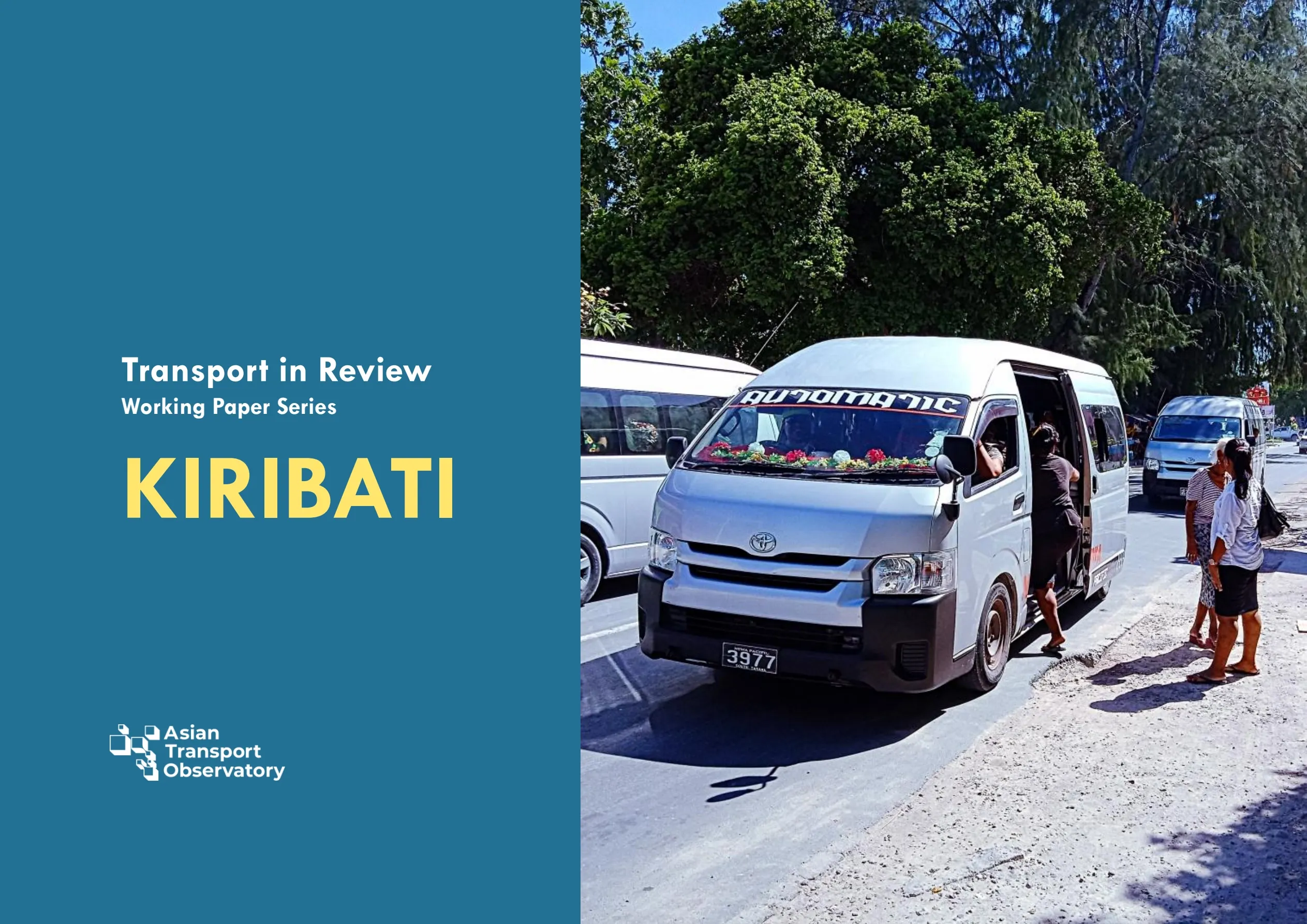
The Asian Transport Observatory (ATO) is pleased to publish a new working paper in the Transport in Review series: "Kiribati – Transport in Review Working Paper Series"
The Transport in Review: Kiribati report assesses the country’s transport system against the realities of extreme geographic dispersion, acute climate vulnerability, and constrained institutional capacity. As a nation of low-lying atolls spread across a vast ocean, transport in Kiribati is not only a service sector but a foundational enabler of economic activity, social inclusion, and national resilience.
The assessment finds that while important strategies and investments are underway, structural challenges continue to limit the performance, safety, and sustainability of the transport system. Access to transport services remains uneven, with pronounced disparities between South Tarawa and the outer islands. Despite national indicators suggesting relatively high rural access to all-weather roads, many outer-island communities continue to face unreliable year-round connectivity due to damaged causeways, unsealed roads, and the absence of basic maritime infrastructure. Maritime “last mile” access remains a critical bottleneck, constraining access to healthcare, markets, education, and essential services, while also posing safety risks for passengers and freight.
National connectivity and freight movement are heavily shaped by geography. Inter-island mobility depends almost entirely on maritime and aviation services, both of which operate under capacity, infrastructure, and resilience constraints. Maritime transport underpins domestic freight movement but is characterized by low liner shipping connectivity, high costs, and aging port infrastructure. Aviation provides vital national and international links, yet remains limited by a small number of airports, low flight frequencies, and deteriorating runway conditions on outer islands.
Urban mobility pressures are most evident in South Tarawa, where rapid population growth and rising vehicle ownership are outpacing infrastructure capacity. Motorization continues to increase, while access to formal public transport remains limited. This growing dependence on private vehicles is occurring in a spatially constrained urban environment with limited scope for road expansion, raising concerns about congestion, safety, and long-term sustainability.
Transport safety remains a persistent public health concern. Road crash fatality rates have increased over time, with pedestrians accounting for a growing share of fatalities. The transport sector is also a major contributor to Kiribati’s energy use and greenhouse gas emissions, accounting for roughly one-third of total national consumption and emissions. The sector remains fully dependent on imported fossil fuels, exposing the economy to external price and supply shocks. Although emissions growth has slowed in recent years, transport emissions continue to rise faster than the regional average. Given that most transport assets are in low-lying coastal areas, climate resilience and decarbonization are inseparable priorities.
Policy frameworks increasingly emphasize climate-resilient infrastructure, improved asset management, digitalization, and the gradual introduction of electric mobility. However, implementation remains at an early stage. Electric and hybrid vehicles represent only a marginal share of imports, and the climate benefits of electrification are constrained by the carbon intensity of electricity generation, despite recent progress in solar deployment. Institutional and technical capacity limitations continue to slow the translation of plans into operational outcomes.
Across all modes, limited capacities and financing constraints remain binding. Maintenance systems are under-resourced, responsibilities are fragmented across agencies, and large-scale investments continue to rely heavily on external development finance. While national strategies clearly articulate priorities related to access, safety, resilience, and decarbonization, successful implementation will depend on sustained international support, stronger inter-agency coordination, and continued improvements in data, planning, and asset management systems.
Click HERE to access the report.