ATO releases Transport in Review Working Paper Series: Samoa
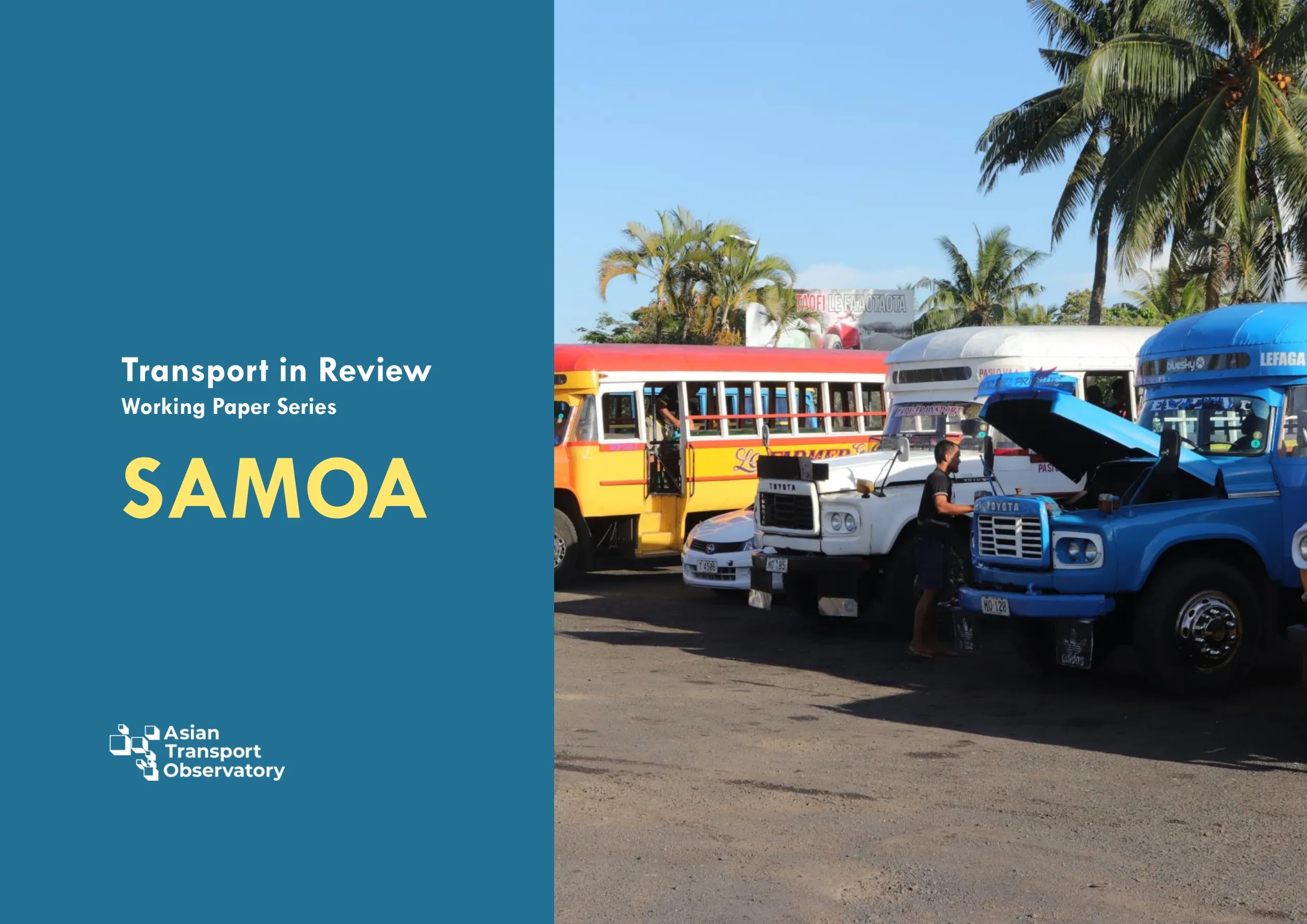
The Asian Transport Observatory has released the Transport in Review Working Paper Series: Samoa, a new diagnostic report that provides a baseline assessment of Samoa's transport sector as the UN Decade of Sustainable Transport gets underway.
The report reviews Samoa's transport system across key sustainable transport dimensions, including connectivity and freight, access, urban mobility, safety, climate resilience, decarbonization, technology, institutional coordination, gender, disability inclusion, and transport finance. It is intended to support government agencies, development partners, and sector stakeholders in strengthening evidence-based planning and policy dialogue over the coming decade.
Samoa's transport sector faces a complex set of pressures. Around 70% of the population lives within one kilometer of the coast, exposing critical roads and transport assets to flooding, erosion, storm surge, and sea-level rise. At the same time, vehicle ownership has grown much faster than the population, increasing pressure on road infrastructure, safety, fuel demand, and emissions.
The review finds that while Samoa has relatively high direct road access, important access gaps remain. A significant share of the population still faces long travel times to health facilities, especially without access to a car. Road safety is also a major concern, with pedestrians representing a high share of road fatalities and crashes imposing substantial economic costs.
The report also highlights Samoa's climate and decarbonization challenge. Transport accounts for a major share of national greenhouse gas emissions, with road transport responsible for most of the sector’s emissions. The report notes that Samoa’s decarbonization pathway will depend on a combination of improved access, more walking and cycling, cleaner buses, smart electrification, and lower-emission freight.
Beyond roads, the working paper examines the role of aviation and maritime transport in connecting Samoa to regional markets, tourism, inter-island mobility, and emergency response. It also underscores emerging public health concerns from maritime emissions, particularly the contribution of older inter-island ships to transport-related PM2.5 exposure.
The report points to two crosscutting issues that will shape Samoa’s progress: financing and data. Official development assistance remains a major source of transport investment, while public-private partnerships are still limited. At the same time, key transport records — including asset inventories, crash data, vehicle and vessel registrations, vehicle activity, and customs data — remain scattered across agencies. Better integration of these datasets could significantly improve planning, prioritization, and accountability.
Many of the policy foundations are already in place, including the Transport and Infrastructure Sector Plan, NDC 3.0, the Decarbonization Strategy, the Sustainable Land Use and Mobility Plan, the National Road Safety Action Plan, and Samoa's asset management and resilience frameworks. The main challenge for the coming decade will be implementation: turning existing strategies, data systems, and institutional mandates into measurable improvements in access, safety, resilience, and emissions reduction.
The Transport in Review Working Paper Series: Samoa was prepared with support from the Asian Development Bank, the Asian Infrastructure Investment Bank, and the World Bank.
Click HERE to access the report.