Presentation
ATO presents at the UIC Asia-Pacific Web Meeting on Advocacy 2025
On 11 September 2025, the Asian Transport Observatory contributed to the session at the UIC Asia-Pacific Web Meeting on Advocacy 2025.
Mel Eden presented "Railway Decarbonisation in Asia Pacific" highlighting rail's transition to decarbonization and the challenges and blind spots it faces.
The presentation talked about:
- Rail drives decarbonization – Evidence showing rail as the most energy-efficient and lowest-emitting transport mode in Asia-Pacific.
- Growth in railway infrastructure lags behind roads – Rail has expanded but still trails road infrastructure in scale and density.
- Investment and resilience gaps – Funding is rising but remains insufficient, and rail, as an expensive asset, is highly vulnerable to climate impacts.
- Momentum in policy and finance – ODA, PPPs, and national strategies increasingly prioritize rail for sustainable transport.
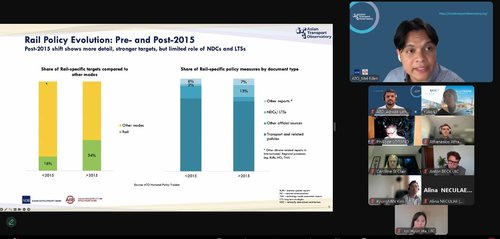
Adwait Limaye also presented on "Rail’s Policy Landscape for Decarbonization and Resilience – Aiming for Convergence: Multiple Actors, One Framework."
The presentation highlighted:
- Rising visibility of rail in climate policy – While road and EV policies dominate, rail-related measures are steadily increasing since 2015, with growing diversity in policy sources.
- Rail in NDCs – Still limited, with only ~20% of Asia-Pacific economies including rail-specific measures, though numbers are slowly improving.
- Beyond NDCs – Countries are adopting broader rail climate measures (e.g., electrification, freight modal shift, resilience, green energy use) that offer significant potential for climate finance.
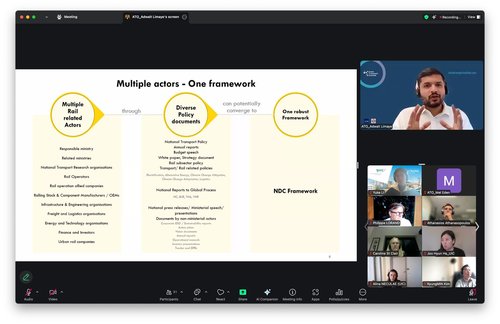
- Framework proposal – Multiple actors (ministries, research bodies, rail operators, manufacturers, logistics and tech firms, financiers, and urban rail agencies) already institutionalise rail-related climate actions through policies, reports, and operational plans. Converging these diverse measures under a single NDC-aligned framework can:
- Align decarbonisation and resilience strategies,
- Demonstrate stronger national climate ambition, and
- Unlock higher levels of climate finance.
This session was attended by UIC staff, resource person at the Asian Infrastructure Investment Bank, and about 20 participants from UIC Asia-Pacific member countries.
Attachments
decarbonizationclimate changeRailway