ATO launches the Asia and the Pacific Transport Development Finance Explorer to strengthen visibility on transport development finance
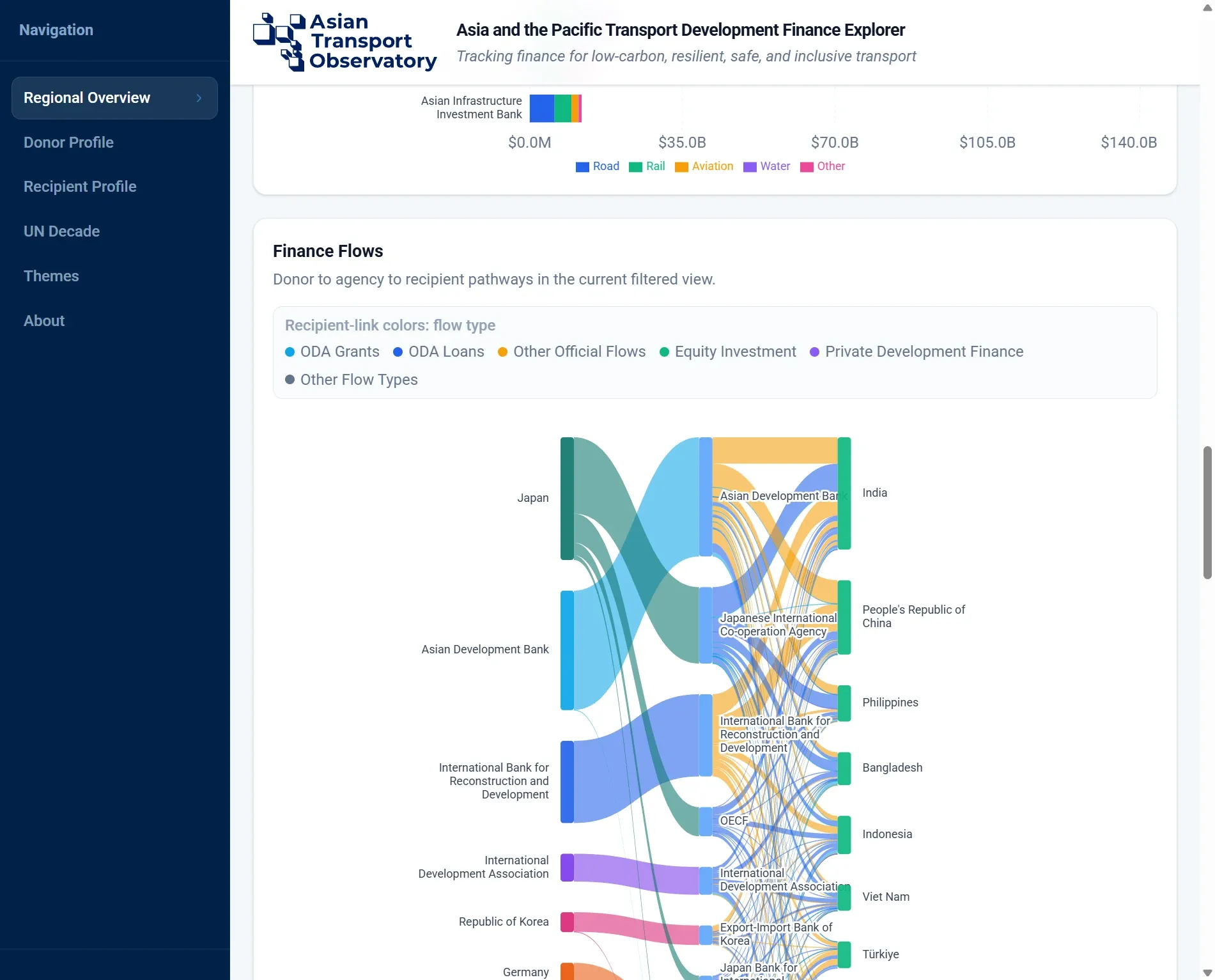
The Asian Transport Observatory (ATO) has launched the Asia and the Pacific Transport Development Finance Explorer, a new interactive platform designed to make transport development finance easier to explore, compare, and use.
The dashboard brings together transport-related development finance records into a single online interface, allowing users to examine commitments and disbursements by donor, recipient economy, broad region, transport mode, recipient scope, and year. The tool is designed to support governments, development partners, researchers, and practitioners who need clearer visibility on how transport finance is being directed across Asia and the Pacific.
The dashboard responds to a basic but persistent challenge: transport finance data is available, but it is often difficult to interpret at the level needed for policy and investment decisions. Users need to know not only how much finance is flowing into transport, but where it is going, which modes are being supported, which donors are active, and how patterns are changing over time.
The explorer helps close this gap by turning project-level development finance data into a more accessible analytical tool. Its overview page consolidates commitments and disbursements by donor, recipient, transport mode, and year, and includes country totals, donor flows, and mode mix views. The platform also includes dedicated sections for geography, flows, and country profiles, making it possible to move from regional patterns to more detailed country and donor-recipient analysis.
Through its global filters, users can refine the data by donor, broad region, country recipient, transport mode, recipient scope, and year. The explorer features a regional overview page, a "donor" profile page, "recipient" profile page, "UN Decade" page—which features tagged information based on the focus areas of the UN Decade of Sustainable Transport— and the "theme" page which features information on bespoke topics such as e-mobility, urban transport, and active mobility.
Built around OECD Creditor Reporting System data, the dashboard turns transport development finance records into an accessible analytical platform. Users can explore commitments, disbursements, and flows by donor, recipient, transport mode, geography, and year, and can move from regional summaries to country-level and project-level views. By separating country-specific records from regional and non-country support, the platform helps users better understand where transport finance is going, who is providing it, and how investment patterns are changing over time. Aside from the OECD data, it also integrates other information such as the climate finance readiness screener, including selected indicators linked to the Data-to-Deal Approach, to help users better understand not only where low-carbon transport finance is flowing, but also where countries may need support to prepare, coordinate, and finance investment-ready transport decarbonization actions.
For ATO, the dashboard is part of a broader effort to strengthen the evidence base for transport policy and investment in Asia and the Pacific. Transport systems are central to economic growth, access, trade, safety, resilience, and climate action. But investment decisions are only as strong as the data and analytical systems behind them. By making finance flows easier to digest, the dashboard can help users identify gaps, compare priorities, and assess whether transport development finance is aligned with national and regional sustainable transport objectives.
This tool was developed with support from ADB's TA-6763 REG: Accelerating Innovation in Transport, under the Pathways for Decarbonization of the Transport Sector project. The project is funded by the Foreign, Commonwealth & Development Office (FCDO) and implemented by ADB in coordination with the Climate Compatible Growth (CCG) program.