ATO brings regional evidence and data to AIIB Transport Knowledge Week 2026

The Asian Transport Observatory (ATO) strengthened its engagement with the Asian Infrastructure Investment Bank (AIIB) in September 2026 through a series of knowledge-sharing sessions with AIIB teams and a substantive contribution to AIIB’s Transport Knowledge Week 2026.
Held from 14–18 September under the theme "Ports for Tomorrow: Green, Smart, and Connected," Transport Knowledge Week brought together policymakers, practitioners, development partners, industry experts, and the private sector to examine the future of ports, logistics, and multimodal connectivity. The program focused on some of the key issues shaping maritime transport today, including hinterland connectivity, decarbonization, climate resilience, digitalization, and the financing of future port and logistics infrastructure.
Bringing an Asia-Pacific evidence base to the discussion
ATO Co-Team Leads Alvin Mejia and Sudhir Gota contributed to the opening technical discussions through a presentation titled "Changing Tides: Progress and Possibilities for Asia-Pacific’s Ports."
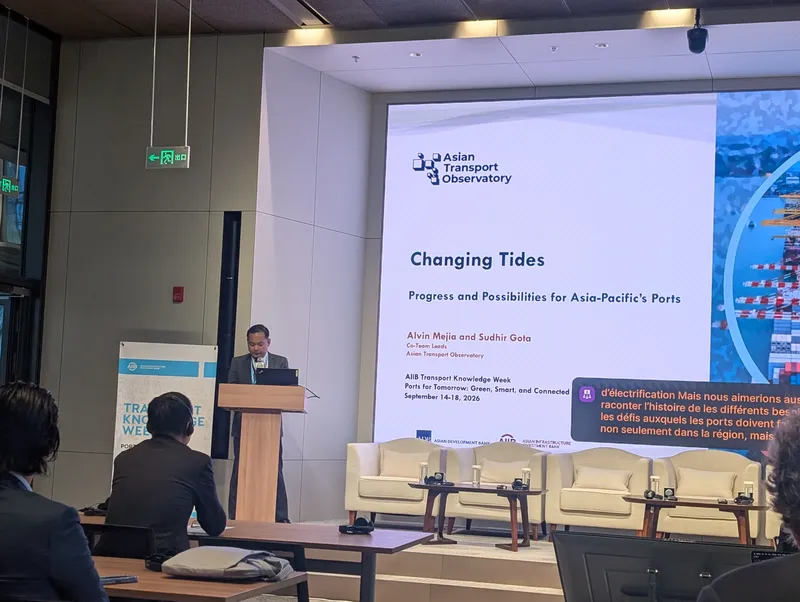
The presentation brought together ATO data and analysis to provide a regional perspective on how ports across Asia and the Pacific are evolving—and where significant gaps remain. Rather than looking at ports only as individual infrastructure assets, the presentation examined the broader issues of investment, connectivity, performance, sustainability, digitalization, employment, and resilience.
Among the messages highlighted was the scale of the infrastructure challenge. ATO estimates that around $70 billion per year in port expansion investment will be needed in Asia, while substantial disparities in port infrastructure remain between lower-income economies and their higher-income counterparts.
ATO also highlighted the uneven nature of maritime connectivity across the region, the strong performance of several East Asian ports, and the need to look beyond infrastructure provision alone. Better links between ports and their hinterlands, supporting policies, institutional arrangements, technology, and resilience will increasingly determine whether investments translate into more efficient and competitive transport systems.
The presentation also brought climate and sustainability considerations into the discussion. ATO analysis showed the importance of strengthening port resilience across both major gateways and vulnerable small island economies. By 2050, Asia-Pacific ports could account for almost a quarter of the annual trade value exposed to climate-change impacts under a high-emissions scenario.
On digitalization, ATO drew on its policy database to show that digitalization and technology still represent only a small share of the shipping-related policy measures currently tracked, pointing to significant scope for policies to catch up with the rapid technological transformation already taking place in ports.
These contributions complemented the wider objectives of Transport Knowledge Week: to identify infrastructure, policy, institutional, digital, resilience, and decarbonization gaps, and to translate international experience into practical solutions and future investment opportunities.
Deepening engagement with AIIB teams
ATO’s contribution to Transport Knowledge Week was part of a broader engagement with AIIB during the preceding days.
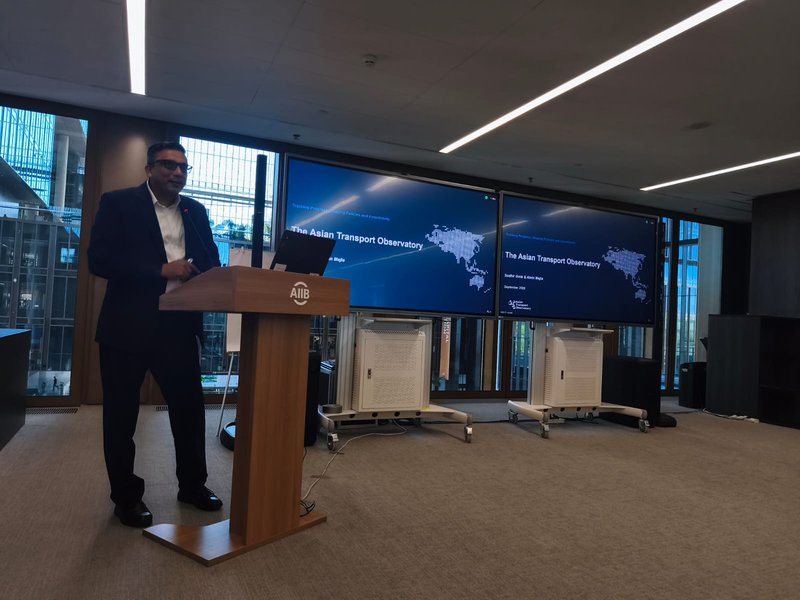
On 10 September, ATO delivered an opening presentation to AIIB staff on “What the ATO Is, and Why It Matters to AIIB.” The session introduced the rationale and scope of the Observatory, highlighted recent products and tools, and discussed how ATO’s regional evidence base can support AIIB’s transport work. This included ATO’s country and thematic profiles, Transport Investment Outlook, SDG analysis, climate and policy trackers, and other data tools.
A central message was that ATO can provide a common evidence base across different stages of investment and strategy development. Its datasets can support upstream country diagnostics and sector assessments, while also providing benchmarks for tracking progress against the Sustainable Development Goals, the Paris Agreement, and other regional and global transport commitments.
The opening session was followed by more focused discussions with AIIB’s Public Sector Clients Region 1 and Region 2 teams, exploring how ATO data, analytical products, and upcoming tools could be applied to country-specific work and to both upstream and downstream activities.
ATO also met with the Multilateral Cooperation Center for Development Finance (MCDF) and teams working on economics, strategy and policy, and environmental and social issues. These discussions provided opportunities to demonstrate relevant parts of the ATO databases, discuss the Transport Investment Outlook and upcoming analytical products, and identify areas where ATO data and analysis could support ongoing and future work. Additional discussions with individual AIIB staff focused on specific countries and thematic issues.
From regional data to operational knowledge
AIIB has been a co-funder of the ATO since 2023, and the September engagements provided an opportunity to connect the Observatory’s growing regional knowledge base more directly with the Bank’s operational needs. ATO now covers 52 economies across Asia and the Pacific, bringing together hundreds of indicators on infrastructure, mobility, connectivity, road safety, climate, environmental impacts, policies, and investment alongside its urban, policy, and project databases.
The discussions at AIIB and the contribution to Transport Knowledge Week demonstrated an important part of ATO’s role: turning dispersed transport data into comparable evidence that can inform policy, investment, and project discussions.
By bringing an Asia-Pacific-wide perspective into conversations on the future of ports—and by working directly with AIIB teams on how its datasets and tools can be applied—the ATO continues to strengthen the link between transport knowledge and practical decision-making across the region.