Asia's low- and middle-income economies will need US$2.6 trillion annually for transport infrastructure by 2035, new ATO outlook finds
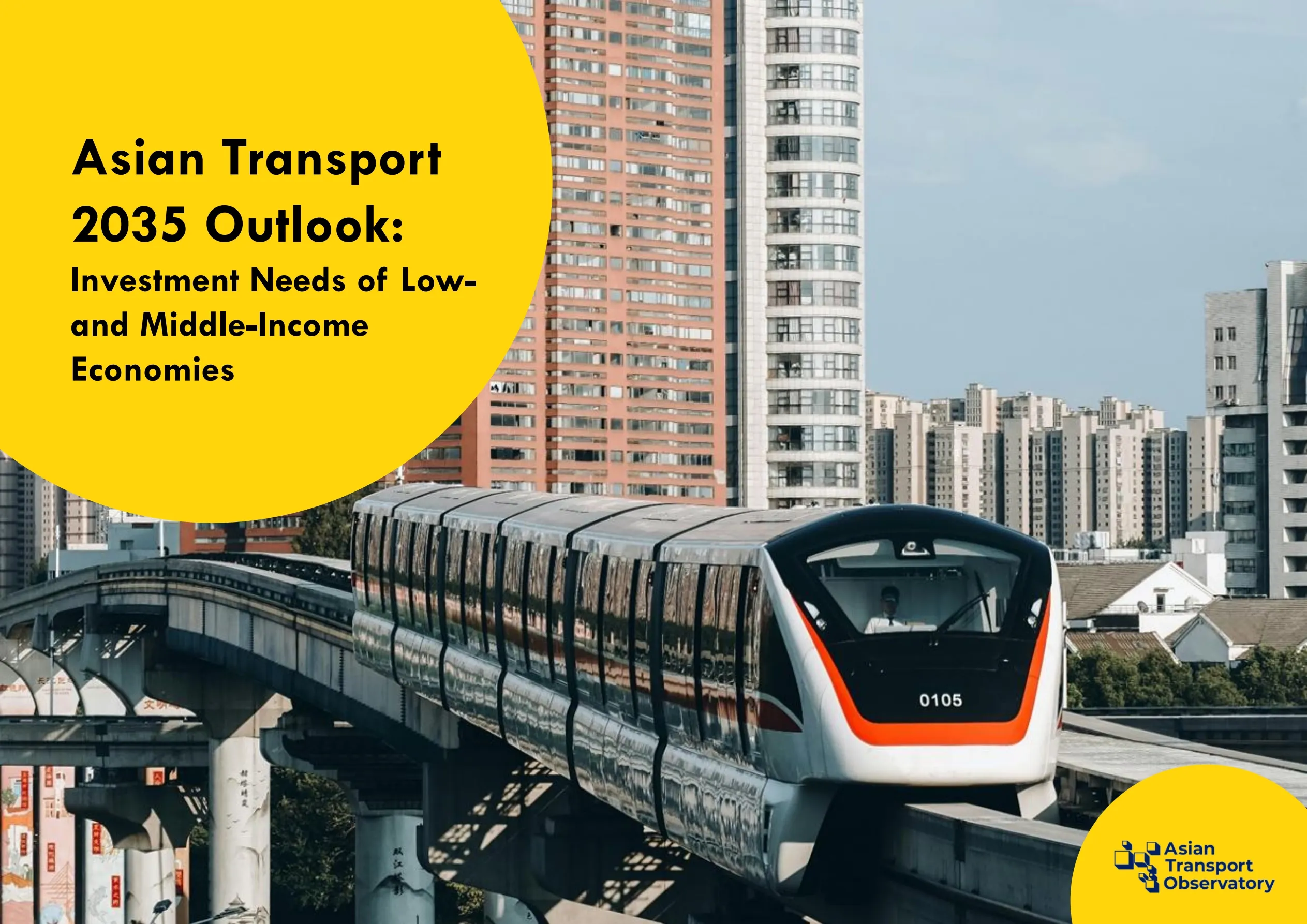
Annual transport infrastructure investment needs could more than triple, rising from about US$800 billion per year over 2000–2025 to about US$2.6 trillion per year between 2025 and 2035.
Manila, May 18, 2026 — Low- and middle-income economies in Asia and the Pacific will need to invest about US$2.6 trillion per year in transport infrastructure between 2025 and 2035, according to a new outlook by the Asian Transport Observatory (ATO).
The report, Asian Transport 2035 Outlook: Investment Needs of Low- and Middle-Income Economies, provides a detailed forward-looking assessment of transport infrastructure investment needs across the region. It finds that annual investment demand across all transport modes could rise from roughly US$800 billion per year during 2000–2025 to approximately US$2.6 trillion per year between 2025 and 2035, equivalent to around 2.3 percent of GDP in low- and middle-income economies. The report notes that this is a conservative projection, as it reflects observed trends and current pipelines rather than the full investment required to meet climate, energy transition, safety, and access objectives.
The Outlook comes at a critical moment for the region. Rising incomes, rapid urbanization, expanding vehicle fleets, trade growth, and the transition to electric mobility are creating new pressure on transport systems. At the same time, many countries face constrained public budgets, rising debt, declining private participation, and growing climate risks.
“The question is not whether Asia needs more transport infrastructure. The question is: how much, and at what cost?” the report states.
Roads remain the largest area of investment. The report estimates that road construction will account for 44 percent of total transport infrastructure investment between 2025 and 2035, or about US$1.14 trillion per year, equivalent to around 1 percent of GDP. Road maintenance will require an additional US$400 billion per year, while road safety components will require about US$65 billion per year.
Despite the scale of planned road expansion, the region’s access gap will remain substantial. Asia’s low- and middle-income economies could add around 3 million kilometers of roads over the next decade, but per capita road availability is expected to remain far below OECD levels. Nearly 396 million people still lack access to all-weather roads. The report also warns that vehicle growth is outpacing infrastructure growth: vehicle numbers may grow by around 3 percent per year, while road networks expand by only 1.4 percent per year
The Outlook also highlights the growing importance of maintenance. Across low- and middle-income economies, maintenance is projected to account for approximately 24 percent of total transport investment between 2025 and 2035. Heavy rail has the highest maintenance share, at 31 percent of sub-sector investment, while road maintenance accounts for about 23 percent of total road investment. Without a major increase in maintenance spending, the report warns that new investment could expand networks while the quality and reliability of existing assets continue to decline.
Rail investment will continue, but growth is uneven. Heavy rail networks in Asia’s low- and middle-income economies could expand by around 60,000 kilometers by 2035, but about two-thirds of this growth is concentrated in two countries. High-speed rail is increasingly being pursued at income levels once considered too low for such systems, but the pipeline is thinner than in the previous decade. Urban rapid transit also continues to expand, but not fast enough to keep pace with urban growth. The report estimates that urban rapid transit availability in Asia’s low- and middle-income economies will rise only modestly, from 8.5 to 10.6 kilometers per million urban residents by 2035.
Ports and airports are also expected to expand. Port area in Asian low- and middle-income economies is projected to grow by 24 percent by 2035, outpacing projected growth in North
America, Europe, and high-income Asia. Airport infrastructure is projected to grow even faster, with aerodrome area expected to expand by 144 percent between 2025 and 2035. Even with this rapid expansion, per capita availability of port and airport infrastructure is expected to remain below high-income economy levels.
For the first time, the Outlook quantifies two areas often missing from regional transport investment estimates: road safety and electric mobility infrastructure. Road crashes cost around US$1.5 trillion annually in Asia alone. The report estimates that around US$65 billion per year would be required for road safety components in low- and middle-income economies in Asia and the Pacific between 2026 and 2035, equivalent to about 3 percent of annual road infrastructure investment. Around 70 percent of this amount is for infrastructure, while the remainder is for soft measures such as planning, enforcement, institutional strengthening, awareness, and monitoring.
Electric mobility will add another major investment requirement. The number of electric vehicles on the road in Asia’s low- and middle-income economies could rise from 144 million to 689 million by 2035, increasing the EV share of total vehicles from 10 percent to 37 percent. Based on published national targets, the report estimates that about 500 million additional charging points will be required between 2025 and 2035. Total charging infrastructure construction costs are estimated at around US$900 billion over the decade.
The financing challenge is as significant as the infrastructure challenge. Official assistance for transport has grown, but it remains concentrated in a small number of countries. Nine economies — India, the Philippines, Bangladesh, Türkiye, the People’s Republic of China, Indonesia, Kazakhstan, Pakistan, and Viet Nam — absorbed 78 percent of official assistance in 2000–2010, rising to 84 percent by 2021–2024.
Private investment through public-private partnerships has weakened. Transport-related private investments peaked at US$173 billion in 2015–2019, but fell to US$82 billion in 2020–2024. Asia’s share of global transport PPPs also declined from 78 percent in 2015–2019 to 61 percent in 2020–2024, even as the region’s share of global ODA flows rose from 59 percent to 65 percent over the same periods.
Climate finance remains a major gap. The report notes that only 0.13 percent of committed transport climate finance in Asia and the Pacific in 2022 was earmarked for adaptation. This is a concern as flood risk, storm damage, and heat stress increasingly affect the long-term economics of transport assets, particularly ports, airports, roads, and railways.
The shift to electric mobility will also affect how governments fund transport infrastructure. Fuel excise duties remain an important source of public revenue in many Asian economies. As electric vehicles replace fuel-powered vehicles, this revenue base will weaken. With EVs
expected to account for 37 percent of vehicles on low- and middle-income economy roads by 2035, the report argues that governments will need to plan carefully for new funding models, including user-based charges where appropriate.
The Outlook concludes that the US$2.6 trillion annual figure is a supply-side projection. It measures estimated investment demand under existing policies. It does not guarantee that investment will deliver safe, reliable, affordable, resilient, and low-carbon transport. That outcome will depend on how countries prioritize projects, maintain existing assets, mobilize finance, and link infrastructure spending to wider public value.
The Asian Transport 2035 Outlook is part of the ATO’s continuing work to strengthen the evidence base for sustainable transport policy and investment in Asia and the Pacific. The ATO is an open-access platform covering 52 Asia-Pacific economies and more than 600 national-level transport indicators, drawing on government sources, international agencies, and secondary research.