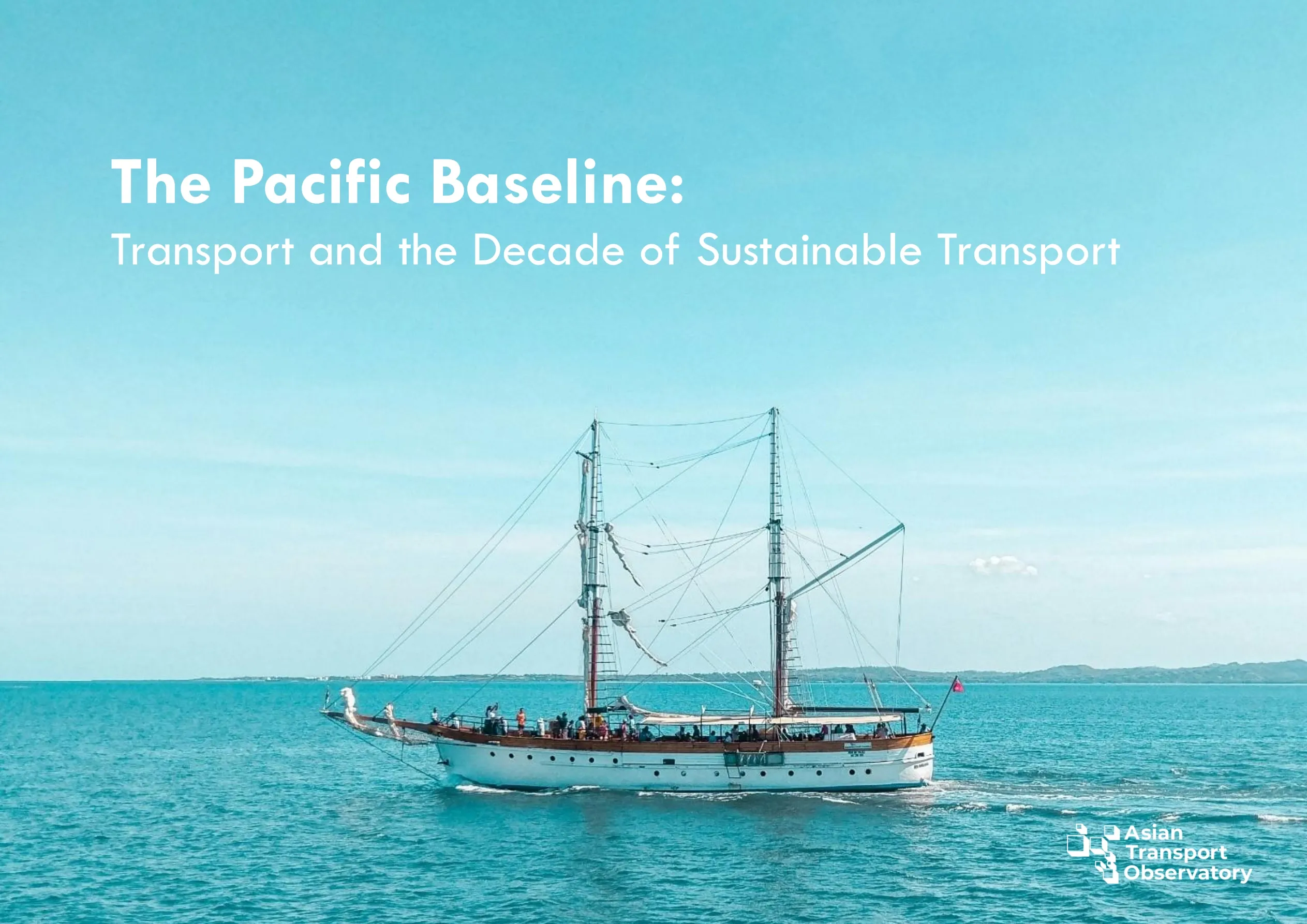
Filename: 2026-07-06b_ATO_Pacific_Regional_Report.pdf
Filesize: 2.2 MB
Downloads: 4
Metadata| DC.title | The Pacific Baseline: Transport and the Decade of Sustainable Transport |
| DC.date | 2026-07-06 |
| DC.creator | Gota, Sudhir |
| DC.creator | Mejia, Alvin |
| DC.creator | Eden, Mel |
| DC.creator | Limaye, Adwait |
| DC.creator | Soco, Benjamin |
| DC.creator | Salang, Aaron |
| DC.publisher | Asian Transport Observatory |
| DC.identifier | https://hdl.handle.net/20.500.14706/01.027.00 |
| DC.format | application/pdf |
| Filename: | 2026-07-06b_ATO_Pacific_Regional_Report.pdf |
| Filesize: | 2.2 MB |
| Downloads: | 4 |
Transport is fundamental to development, resilience, and everyday life in the Pacific. For island countries spread across vast ocean distances, transport is not only about moving people and goods. It determines whether communities can reach schools, health services, markets, ports, airports, and economic opportunities, and whether countries can stay connected when climate events, fuel price shocks, or service disruptions occur.
The Asian Transport Observatory's report, The Pacific Baseline: Transport and the Decade of Sustainable Transport, provides a regional baseline as the United Nations Decade of Sustainable Transport 2026–2035 begins. Covering 14 Pacific island countries, the report brings together more than 40 indicators to assess transport systems across the main focal areas of the Decade, including access, connectivity and logistics, low- and zero-carbon transport, resilience, urban mobility, safety, innovation, and transport finance.
The report shows why sustainable transport in the Pacific must be understood through the realities of island geography, population dispersion, maritime and aviation dependence, imported fuel reliance, climate vulnerability, and small transport markets. Conventional measures of infrastructure and vehicle movement only tell part of the story. In the Pacific, the more important question is often whether people, goods, and essential services can remain reliably connected.
The analysis highlights persistent access gaps, weak public transport coverage in many cities, limited maritime and aviation connectivity, high dependence on imported petroleum fuels, rising vehicle ownership, growing aviation energy demand, exposure of roads and ports to climate hazards, and large fluctuations in transport financing. It also shows areas of progress, including improving transport emissions intensity in some countries and growing evidence of policy attention to electric mobility, resilience, and regional connectivity.
This baseline is intended to support governments, development partners, regional organizations, researchers, and practitioners as they track progress during the Decade of Sustainable Transport. Future updates will help identify where the Pacific is moving forward, where progress is uneven, and where regional cooperation can make the greatest difference.
Cookies used on the site are categorized and below you can read about each category and allow or deny some or all of them. When categories than have been previously allowed are disabled, all cookies assigned to that category will be removed from your browser. Additionally you can see a list of cookies assigned to each category and detailed information in the cookie declaration.
Some cookies are required to provide core functionality. The website won't function properly without these cookies and they are enabled by default and cannot be disabled.
Analytical cookies help us improve our website by collecting and reporting information on its usage.
Cookies used on the site are categorized and below you can read about each category and allow or deny some or all of them. When categories than have been previously allowed are disabled, all cookies assigned to that category will be removed from your browser. Additionally you can see a list of cookies assigned to each category and detailed information in the cookie declaration.
Some cookies are required to provide core functionality. The website won't function properly without these cookies and they are enabled by default and cannot be disabled.
| Name | Hostname | Vendor | Expiry |
|---|---|---|---|
| sessionid | asiantransportobservatory.org | Asian Transport Observatory | 2 weeks |
|
Used by the website for authentication. |
|||
| csrftoken | asiantransportobservatory.org | Asian Transport Observatory | 24 hrs |
|
Used by website to protect CSRF vulnerable resources. |
|||
Analytical cookies help us improve our website by collecting and reporting information on its usage.
| Name | Hostname | Vendor | Expiry |
|---|---|---|---|
| _ga | .asiantransportobservatory.org | Google Analytics | 2 years |
|
Used by Google Analytics to distinguish users. |
|||
| _ga_Z5W4M9226H | .asiantransportobservatory.org | Google Analytics | 2 years |
|
Used by Google Analytics to to persist session state.. |
|||
| _clck | .asiantransportobservatory.org | Microsoft Clarity | 1 year |
|
Persists the Clarity User ID and preferences, unique to that site is attributed to the same user ID. |
|||
| _clsk | .asiantransportobservatory.org | Microsoft Clarity | 1 year |
|
Connects multiple page views by a user into a single Clarity session recording. |
|||
We use cookies to analyze our traffic. For these reasons, we may share your site usage data with our analytics partners.
By clicking "Allow All", you consent to store on your device all the technologies described in our
GDPR and Privacy Policy page.
You can update your cookie settings by visiting the 'Manage Cookies' link in the footer.